
Does Microsoft Have an AI Problem?
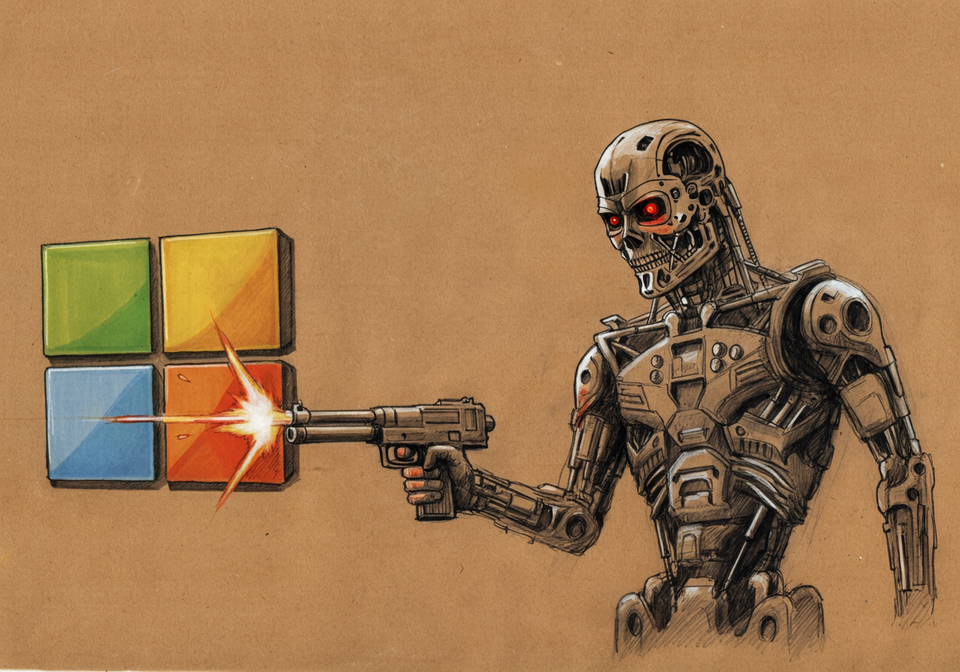
There's a lot of smoke, namely in the form of various reports, that Microsoft has a burgeoning AI fire on their hands. To be more specific, they're perhaps having a hard time convincing customers, both on the consumer and enterprise sides of the coin, that most of the newfangled features and functionality are actually useful – let alone worth paying coin for...
The latest such report is from Aaron Holmes for The Information. Over the course of 2,000 or so words, he makes the case Microsoft is having a hell of a time trying to convince customers to adopt, use, and pay for the "Copilot" features recently added on to the Microsoft 365 work suite of software.
"So far, we’ve had mixed results. Most people don’t find it that valuable right now, but it’s a product that’s going to improve over time."
That's Viral Tripathi, Ascension’s CIO, which has about 100 employees at their technology consulting firm trying out Copilot.
"We’re still evaluating Copilot. Some people were, like, 'This is really annoying.'"
That's Rajesh Naidu, the Chief Architect at Expedia, which is also trying out 365 Copilot amongst its employees, but hasn't rolled it out more broadly.
There are a couple good quotes from competitors as well in there – namely Salesforce CEO Marc Benioff and Thomas Sausserig, an executive board member at SAP – and while those are perhaps to be expected in a competitive environment, it's hard to imagine quotes saying that their own customers see Copilot as a "disappointment" and "stupid" if Microsoft was really nailing the product right now. Instead, the number of partners actually paying ($30/month) for Microsoft's AI right now seems tiny:
So far, only a small portion of Microsoft’s business customers has adopted Copilot: Between 0.1% and 1% of the 440 million existing users of Microsoft 365 are also paying for the new AI features, equity analysts estimate. That translates to between 400,000 and 4 million paid seats for the Copilot product, which could mean the product is on track to generate hundreds of millions of dollars in revenue annually.
It's early. And Microsoft has already announced a new event – with the very Microsoftian titled: 'Microsoft 365 Copilot: Wave 2' – to give some presumably big updates on the offering. But this isn't an isolated report.
A month ago, there was a report that Microsoft's AI business was doing well on at least one front: selling ChatGPT to customers through Azure. The problem there is that OpenAI is now unexpectedly doing an even better job selling their own products to such customers. This is not only awkward, but it literally undercuts Microsoft's business model.1 But at least they're still getting paid for ChatGPT's cloud-usage, I guess? Of course, that's perhaps largely with Microsoft's own credits. At least until Apple comes into the mix.
Morphing more over to the consumer side, just yesterday was a report that Microsoft's much ballyhooed 'Copilot+ PCs' are in fact pretty awful when it comes to gaming. Just of the games tested, over half ran poorly on these machines which Microsoft and Qualcomm have touted for their speed, and many games didn't run at all due to compatibility issues. Those companies would have you believe these are mere hiccups in a transition to ARM-based Windows, but Intel and AMD are also about to get their own x86 'Copilot+ PCs' in the market. It's not clear just how much of a transition there's actually going to be. Especially since the key selling point of these newfangled 'AI PCs' is, yes, AI. And there again, the early results are mixed at best. And seem rather pointless, at worst.
I mean, we have Best Buy employees, tasked with selling these machines and ushering in a new "AI PC supercycle", calling Window's new AI features "largely gimmicks". And those are the features that actually shipped. 'Recall', which seemed like the most interesting use of AI within Windows has ended up being a comedy of errors – perhaps a nearly terrifying one – to the point where Microsoft pulled it and now keeps delaying it.
At the same time, Apple seemingly showed Microsoft how you should do consumer AI, at least for now. That is, subtly bake it into products and tasks that customers are already using and doing. And do so slowly, as the technology continues to change at a rapid pace on the cutting edge. Microsoft perhaps isn't as bad as Meta with regard to shoving AI in users faces, but they're closer to that than what Apple is doing. Back to Expedia's Naidu:
"Other people had PTSD because it reminded them of Clippy," Microsoft’s much-maligned Office assistant, introduced over 20 years ago.
Definitely not the comparison you want being made here. After Apple's announcements in June, I wondered if Microsoft may have to go back to the drawing board with their consumer AI offerings in light of Apple's moves. As I wrote in 'Can Microsoft Build 'Apple Intelligence' in Reverse?':
It's entirely possible that WWDC is looked back upon as the moment when AI shifted from a performance arms race, to a product one. Apple didn't focus on how large their LLMs are – because they're not the largest, of course – instead it was all about what you can do with them. Notably, that includes tangible tasks that involve the people and information closest to you.
And per Holmes' report today, Microsoft is shifting some of their AI work from OpenAI's model to their own, smaller 'Phi' models to both help with costs and to better tailor the AI for specific tasks. As I continued:
It sure sounds like Microsoft is in the process of working on how to create new products using new models they create in-house (beyond the small Phi models which they've had for a bit), rather than in partnership with OpenAI. And so in a way, what Microsoft may end up doing here is sort of what Apple just did, but in reverse.
They started with the OpenAI partnership, and specifically ChatGPT powering their initial forays into AI. With that not working as well as Nadella would like, at least on the consumer side from Bing on down, the focus is undoubtedly going to be on a symphony of models that are tailored for personal and private experiences. ChatGPT will go from the main event to a sideshow.
As noted, Apple has done the opposite, building their own models for the main jobs to be done with AI and using OpenAI (and soon other cloud-based models) to catch the rest of the AI workloads that customers demand.
Microsoft, perhaps, put the cart before the horse here. And now they're seemingly hedging the hell out of that cart to get the horse back in front. The relationship status with OpenAI is now complicated, and seemingly getting more so by the day.
But stepping back to the issue at hand, beyond perhaps GitHub's implementation of Copilot, not a lot seems to actually be working for Microsoft with regard to AI at the moment. There's a lot of talk and even more hype, but not a lot of real world success. Remember when Bing was going to take the fight to Google with its new AI powers? Make them "dance"? Oh, you don't? And you're not using Bing yet? Strange. Google may now be dancing, but it has nothing to do with Bing.
And so we have a business model question as old as time: how do you get people to pay for your AI when you can't even convince them to use your AI? Back to Holmes' report:
“My sense is that organizations’ ability to absorb the innovation is not nearly as great as the innovation that’s coming their way right now,” Jared Spataro, Microsoft corporate vice president, said. “And that’s a statement about how budgets work. They can’t even scrape together the right budgets to buy this stuff.”
Oh yes, they're not paying for it simply because there's no budget to pay for it. Sure. More likely: if the products were great, the money would find a way to flow to Microsoft. But the products aren't great. So the purse strings remain pulled in. And may be for quite some time:
One factor that may be holding some companies back from buying 365 Copilot for more of their employees is the competition from free alternatives—including one from Microsoft itself. Tech executives at large companies say it’s not always clear 365 Copilot is worth the money when they can experiment with the free version of OpenAI’s ChatGPT and Microsoft’s free Copilot version, a chatbot that operates within a web browser and doesn’t sit inside Office 365 apps.
The report cites both Lumen Technologies and Booz Allen Hamilton opting to use free versions of Copilot and ChatGPT, respectively.
Personally, I pay for a handful of AI products right now, but largely just to test them out and see what actually works for my workflow. Once I figure that out, I'll undoubtedly cut back to one or two. I suspect most others will do the same. And while companies may have a bit more leeway and needs for more granular AI tools, the budget will not be infinite, obviously. And so Microsoft is really in a race to prove itself as one of the AI providers worth paying for. They can (and undoubtedly will) try to bundle the features more closely, just as they shoved Teams in everyone's face, but there's always backlash risk there and ultimately, Microsoft needs to upsell AI given the billions of dollars they're pouring into it.
And, increasingly, OpenAI just complicates that math equation for them. What was an ingenious way to bootstrap their AI work while also keeping it at arms-length for regulatory and other concerns may ultimately be a bit of a albatross around Microsoft's neck as the technology matures. Watch this space.
The current proven use cases for AI, again beyond coding within GitHub, aren't really in Microsoft's wheelhouse. They're more in Google's and Apple's. Microsoft would hope to crack the Office AI nut, but how much of that is simply going to be the ability to use natural language to do something? And how many people are going to want to pay for just that? Perhaps less than are willing to pay Clippy to stop annoying them about AI features they'll never use.

 M.G. Siegler
 M.G. Siegler
 M.G. Siegler
 M.G. Siegler
 M.G. Siegler
 M.G. Siegler
1 Not helped by the fact that the largest of those customers is TikTok, which may or may not be paying for ChatGPT access to help ByteDance train its own models...
Member discussion