
Of Tadpoles and Tentpoles
Inside Out 2 proved to be a hit in its opening weekend at the box office! A big hit even! Hollywood is back!
Nope, still screwed.
With the current theatrical situation, that is. And these successes actually just underscore the issues. As if this week's success matters less than last week's failure. This type of framing just masks the completely untenable situation underneath. The movie theater business, as we knew it, is over. No one wants to admit it, and certainly not Hollywood, even though it's beyond obvious, and has been for years.
Movies like Inside Out 2 can and will always have a home in movie theaters, so this weekend proves nothing other than Disney can still figure out the correct model for success when they actually put their mind to it and not to, well, way too much other stuff. But much of the IP of Disney and a handful of other big franchises (meaning both properties and stars), are increasingly an outlier. The movie theater industry needs to be much smaller and more selective than it is right now to survive longterm.
Part of the issue is headlines like the ones from this weekend. Again, Inside Out 2's numbers are strong. But they're not as strong as the story suggests because the story – like most stories about the box office – refuses to account for inflation, while at the same time comparing the new movie to the performance of an old one. For example:
It was the second-biggest opening weekend in Pixar’s 29-year history, trailing only the superhero sequel “Incredibles 2,” which arrived to about $180 million in 2018.
“They’re back,” David A. Gross, a film consultant who publishes a newsletter on box office numbers, said of Pixar. “This is a sensational opening.”
Again, great opening, but if we're at least trying to compare apples to apples here, you might note that a $180M opening in 2018 is equivalent to $215M in 2024 dollars. In other words, Inside Out 2 actually opened to $70M less than Incredibles 2 when adjusted. Again, I'm not saying it's not a big success – certainly it outperformed expectations meaningfully – I'm just saying you can't make that comparison without normalizing the numbers. You just can't.
And while I've been harping on this nonsense for years, you'd think we'd all know a bit more about inflation given the period of time we all just lived through, with overall inflation rising out of control before the central banks around the world were able to reign it in with rate hikes.
And my numbers aren't perfect either because box office ticket prices have far outpaced general inflation over time. Box Office Mojo has long done the yeoman's work of trying to equalize the box office for updated ticket prices, but they sadly only do it for the All Time Domestic Box Office chart – which, yes, looks far different than the non-normalized all-time revenue chart.1
To drive this point home, perhaps you'll notice that no movie released after the year 2000 even cracks the top 10 in terms of inflation-adjusted all-time box office (below). The only movie from the 1990s on the list is Titanic, at #5. Before that, the only movie from the 1980s is E.T. at #4. There are three movies from the 1970s (Star Wars, Jaws, and The Exorcist). Two from the 1960s (both in 1965, incidentally, in The Sound of Music and Doctor Zhivago). One from the 1950s (The Ten Commandments). And two from the 1930s (Gone with the Wind, still #1 overall, and Snow White).
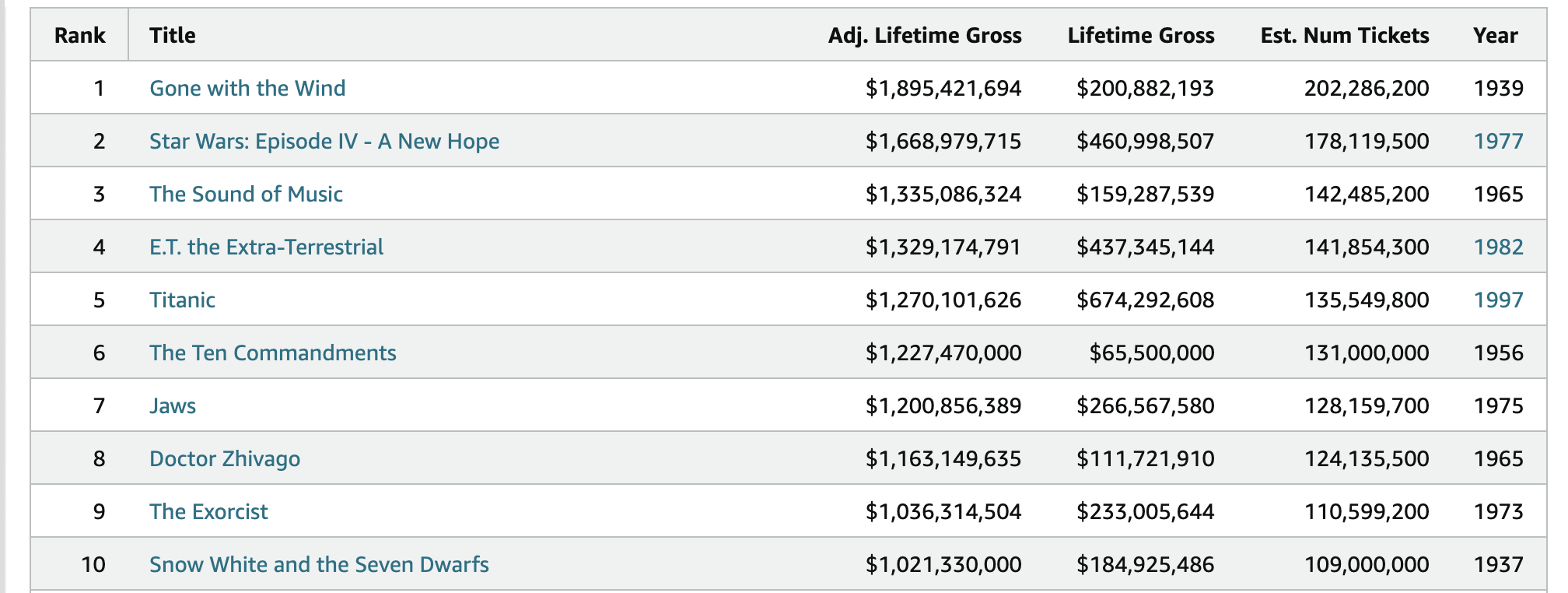
The only recent movie that makes the cut is The Force Awakens at #11. That's the movie which is #1 overall when not counting ticket price inflation. #2 on that list, Avengers: Endgame is #16 when inflation is taken into account.
You'll notice that Box Office Mojo estimates the number of tickets sold. Wouldn't it be great if that was the actual reported number instead of revenue? Well, it wouldn't be for Hollywood since it would very severely highlight reality: that overall movie-going has been in decline for about 80 years now.
Again, that's why despite the movies like Inside Out 2 that occasionally pop up and do well at the box office, the entire movie theater industry really needs to be reworked for reality.
How? Let me propose a simplified 10-step framework here:
- Cut the number of screens in half. We'll probably need more drastic cuts, but let's start with half. Keep the independent theaters open, cut largely from the AMCs of the world. Those theaters mostly suck anyway and undercut the entire industry and experience.
- When a movie slate is being rolled out at a studio, there are "tentpoles" and "tadpoles" – yes, this sounds demeaning, but it's just a cute framing to make it easy to understand and lines up with a way Hollywood has long mapped out their slate. Tentpoles go to theaters, tadpoles go elsewhere, likely to streaming (streaming, get it?). There are very few Tentpoles. There are many Tadpoles.
- Tadpoles that do well on streaming have the opportunity to swim upstream to Tentpoles. Streamers can note how they've caught some zeitgeist and could move them to theaters for a limited run. But more likely a sequel may be in order that goes to theaters as a Tentpole.
- Tentpoles can and will still bomb from time to time, but they can quickly be shifted to streaming where they can still benefit from all the marketing done to promote the tentpole in theaters. A flopping fish suddenly becomes a big fish in a little pond, and all that.
- The reduced number of movie theater screens reworks the industry's supply/demand equation. There's more demand for people to go to theaters which are now more exclusive. As such, there's more demand to book out those theaters with content that will perform well there.
- But it's much more fluid than a movie being released and staying there for weeks. It may have to change on a nightly basis in some theaters. We can do this, we have the technology.
- Theater owners get to decide what they run – including if they're owned by studios, which is increasingly likely to happen. Those studios will then clearly prioritize their content, but that's okay now unlike in the 1940s when the Paramount Decree was put in place, because streaming has leveled the playing field. If a studio is only booking their own movies in their theaters, the market can and should vote with their lack of butts in seats (unless the content is good, of course). But other content should be able to play in studio-owned theaters too, just as it does on the streamers that many of them own now.
- Related, there's no reason why only movies should be allowed to run in movie theaters. I know many creatives would prefer this, but again, the world has changed. If a finale of Game of Thrones is coming up, you put that in theaters and watch the money roll in. Huge sporting events too!
- Ticket prices change based on demand. Wild concept, I know. Matinees at 3pm are already cheaper than showings at 7pm, but the prices can be more fluid (read: get cheaper) to drive more demand. Better seats cost more money – just like with sporting events and actual theater. Wild concept, I know. There might even be a secondary market for premium seats to popular showings...
- The theaters themselves are true movie palaces, not just sort of cramped rooms that smell weird and feature a screen perhaps only slightly larger than your screen at home. There is pre-show entertainment on screen (something which Alamo Drafthouse has done brilliantly over the years). And there are great food and drink options, beyond just the standard popcorn and soda. This is a great night out. Or a great day event with your kids. The key is that it's a communal, special experience that you can't replicate at home, even if you can replicate the screen.
All of the above is obvious stuff. But Hollywood absolutely refuses to do it because it means looking themselves in the mirror and admitting the the current system, a system which built up the entire Hollywood apparatus, is over. No one wants to admit this beyond those with any real business sense. And those savvy enough to know that one good weekend won't change a thing. The wall has already been hit, but so many keep screaming as if they're about to crash.
I'm not saying movie theaters go away, I'm saying that method of distribution is far more exclusive than it is right now. A rebalancing happens to acknowledge the world in which we live. The world of Netflix – which, yes, will also use theatrical distribution for their largest films and biggest hit shows. But also the world of IMAX, which is sort of a microcosm of the plan laid out above.
Hollywood has to drive this change, the movie theaters are never going to do it because it's a (necessary) massive downsizing of the business. Again, this is likely why studios (and the new tech players) may have to fully step in here. Sony's purchase of Alamo is one step. When AMC goes down though, the shit is really going to hit the fan.2 Action!
1 And Box Office Mojo, now owned by Amazon, only has ticket prices up to 2022 right now. ↩
2 Oh my god, I made it an entire article about upheavel in Hollywood without mentioning "AI" once. Funny that. ↩