
DeepSought
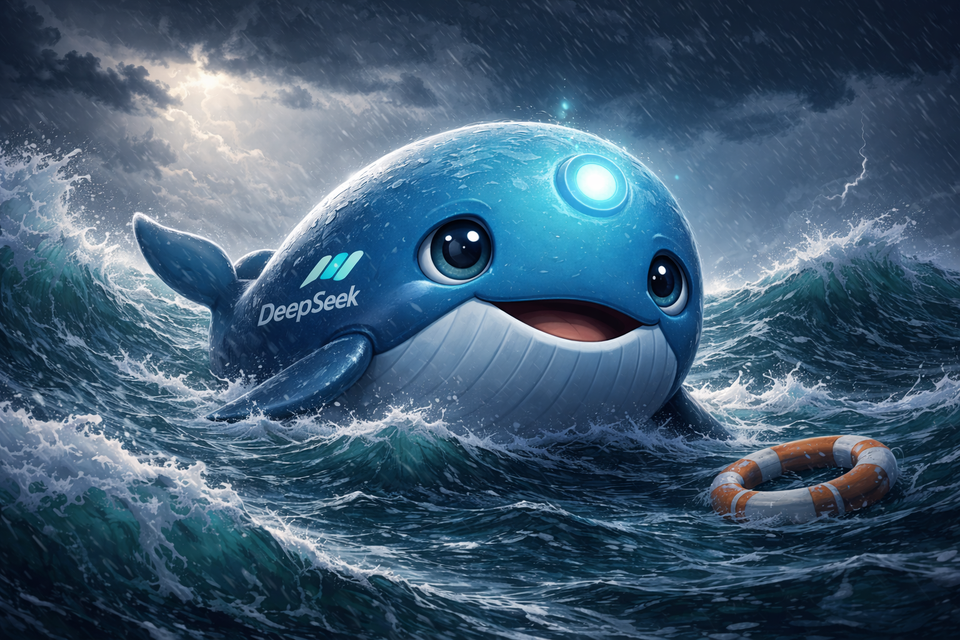
A year ago, the world changed. On January 20, 2025, DeepSeek released their 'R1' model and within a week, the burgeoning AI Bubble had burst and as a result, NVIDIA's share price plummeted. This, in turn, brought down the entire stock market. We entered a new era of "AI Winter" where cheap, open-source models replaced the insanely-expensive-to train-closed variety from OpenAI, Anthropic, and others. China, in a way, had won.
That, of course, is not what happened.
The "DeepSeek Moment" ended up as more of a hiccup. A "Sputnik Moment" that sputtered. Well, that's not exactly fair. Because it was still an important moment, but more of a teaching one in that it was in part a bit of a wake up call and another part a gut check. But not exactly a moment that changed everything.
I suspected as much at the time, noting a couple days later:
On Monday, just before the markets opened, I did an "emergency pod" with Alex Kantrowitz for his Big Technology podcast around this news. Beyond the initial reactions, I think we hit on a lot of what is now playing out. And actually, about 34 minutes in, we start to talk about what I suspect is the ultimate takeaway from all of this: DeepSeek's real fallout may have less to do with DeepSeek the company/model/product and more to do with the wake up call it provided to those powers that be.
Said another way, everyone seemed to be locked into the notion of scaling that we were blinded to any other possible way of doing things. Even if DeepSeek is embellishing just how much money and compute was required to create their models, it doesn't really matter. The reaction from the stock market down to the startups has made it abundantly clear that there's room here to think differently about how to approach the continued build out of AI.
To be clear, NVIDIA's stock did collapse on that day exactly a year ago. The 17% drop wiped out about $600B in market cap, which remains the all-time record. But within a couple of weeks, the stock had largely bounced back, though it remained depressed until the Summer, when the fallout had fully cleared and NVIDIA became the first $5T company. That drop, as it turns out, was simply a buying opportunity.
A couple of weeks after DeepSeek's moment, things were more clear still:
Really, looking over all of these and taking a step back: is anything all that different than it was before DeepSeek detonated two weeks ago? Not really! Again, it’s just a mentality shift that has taken place across all of these sectors and companies. That’s undoubtedly a good thing — it’s always good to pause and revisit your strategy — but it’s not clear just how much will ultimately change in the long run. It's worth questioning that too!
Is Europe going to win in AI now? Are more startups going to succeed? Is Big Tech going to spend less? Is OpenAI going to raise less? The answers here are obviously not going to be black and white, but my point is that you could certainly make the case that nothing much actually changed as a result of DeepSeek in the longer term. And again, that’s largely because it just really highlighted what was always going to happen anyway.
What everyone was seeking is what was already seeking them. Deep, I know.
While Lina Khan and others – including Sam Altman and Satya Nadella – were busy trying to fit DeepSeek into their own narratives the reality was just far more nuanced. Though, as I argued at the time, really, so was Sputnik itself:
So again, I go back to the notion that DeepSeek itself matters less than what it inspires. Maybe what we really hope for here is that it simply sped up progress, even just a bit, clearing heads and roadblocks. While the notion of this being a "Sputnik moment" is now being played up as hyperbolic, perhaps it's better to simply read it literally. When the Russian satellite launched in late 1957, the US was already close to space. In fact, were it not for some trepidation and bureaucracy, many believe that we could have gotten there first. It was a kick in the ass, not a fundamental rethinking of everything. Sometimes, that’s all you need. It lit a fire that stayed lit through a trip to the moon. Back to work.
I bring this up both because it has been a year, but also because DeepSeek is on the verge of releasing their long-awaited next flagship model. 'V4' should be here in a matter of weeks. You can tell this not just from the reporting on the matter, but also the fact that both Alibaba and (the Alibaba-backed) Moonshot AI pushed out their own new models this week, clearly to get ahead of DeepSeek.
To be clear, 'V4' won't be a direct follow-up to 'R1', but instead to 'V3', which was the model released in December 2024 that laid the groundwork for their reasoning model breakthrough. It's unclear when 'R2' is coming – given all the delays, it's entirely possible that it's baked right into 'V4' – but it's also unclear it matters now. All eyes will be on just how close DeepSeek's flagship model can get to the top models – the focus is seemingly on coding. And, of course, how they trained it. Again, the true breakthrough a year ago.
The first post I actually wrote about the company was on that day because it was also when DeepSeek's app had shot to the top of the App Store charts, supplanting ChatGPT. A year later and the app is outside of the Top 500, at least in the US App Store. ChatGPT is back at the top.1
Yet DeepSeek still matters, just in a different way. Beyond the way it was trained, it has helped China secure a lead in "open source" models – especially once Mark Zuckerberg decided to shoot Llama in the head and start over. Much of the rest of the world seems happy to have cheaper, more extensible alternatives to the big model makers. You know, just in case.
But again, where exactly China is in the "AI Race" is the subject of much debate at the moment. While some in China are saying that they're still lagging behind the leading US firms – and that perhaps the chasm is growing – Mistral's Arthur Mensch said this was a "fairy tale" last week in Davos. Google DeepMind's Demis Hassabis was less certain, saying that the cutting edge of the Chinese AI work was still six months behind the US. The new DeepSeek release will presumably clear this up a bit...
But not entirely because obviously the US and China are still going back and forth and then back and forth again over exactly which NVIDIA chips – if any – will be allowed to be legally shipped into the country. Any legally sanctioned sales will obviously be a huge boon to NVIDIA's business, as they have basically written that business down to zero. It will also, of course, oddly help the US Treasury as they get a cut of those would-be sales.
China's lesson from DeepSeek would seem to be that the restraints placed around AI forced their companies to innovate to catch up faster. And their clear hope would be that this will work with AI chips as well, as it will force Huawei and others to try to catch NVIDIA, faster. At the same time, China probably can't afford to sit back and let their companies fall behind if that strategy doesn't work.
Never mind that a lot of these companies can simply train models in other countries using NVIDIA chips that are not two generations old. There are still a lot of moving pieces on the board...
And that includes back in the US, where a growing number of players are starting to think beyond LLMs. Many now believe that achieving AGI, let alone "Superintelligence", will require at least a few new breakthroughs. While others believe it will be impossible to make robots fully work without "World Models" – which is obviously a focus in China as well, where a different type of AI bubble may have formed...
Anyway, we'll see what, if any, deep impact DeepSeek has with a new year and new model. But I'll give the last words to Hassabis, who was chock full of good quotes at Davos last week: "I think it was a massive overreaction in the West."
 M.G. Siegler
 M.G. Siegler
 M.G. Siegler
1 Though it risks being taken down by a social network called UpScrolled which is surging on the back of TikTok's sale to US investors and concerns that there's already content moderation going on – cue Alanis Morissette. ↩