Will OpenAI Ads Click with Users?
The ads are coming! The ads are coming!
Look, everything in OpenAI's blog post announcing that advertising is coming to ChatGPT seems reasonable. Fidji Simo smartly frames it as wanting to ensure they can bring their AI to more people, but at the same time, as everyone is well aware by now, it costs a lot of money to do that. Charging for more/better/faster access has worked well to date for the company, but that model will never be able to scale the way 'free' and/or 'cheap' can. It's a story as old as time – or at least, as old as advertising. Sam Altman may have said that he hoped to avoid this fate – "a last resort" – but it was always inevitable. You either die as an ad-free service or you live long enough to become an ad vessel.1
That's a bit unfair. But it's directionally true. And it's exactly why you hire someone like Simo to be the CEO reporting to the CEO. She has all the experience to make this work for OpenAI, not only thanks to her Meta days, but her Instacart days as well. She has been able to help get advertising working across several different types of businesses (and I think Instagram should be considered slightly different from Facebook itself – we'll get to that).
So, will this work for OpenAI?
I mean, the short answer is that it has to. Given the costs involved and the competition keeping pricing in check, this will be the only way to scale to billions without breaking the bank – which still might break, even with ads, by the way. The problem is that OpenAI clearly doesn't yet know how it will work. Because no one does. It's a new product and new type of experience – and my guess would be that to truly work, it will require a new type of advertising.
Google is the Google you know today because they figured this out. Meta is Meta because Facebook – and again, later Instagram – figured this out.
Conventional wisdom right now would suggest that the right ad model is going to be closer to that of Google because much like Search, what you type into a text box is key. And much like with Google Search, such text often indicates an intent of some type. But whereas Google aimed to match this intent with a website – well, at first, at least – ChatGPT tries to get you right to an answer. This is a problem for the Google-style of advertising because that was predicated around the notion of a click. Famously, because it's trying to get you the information directly rather than linking to a site that has the information, there are far fewer clicks on ChatGPT.
But Google's model was even better than that. Because a user was trained to know they'd be getting those famous "10 blue links" back as a result, they were also trained to quickly scan them. Sure, Google would try to surface the one it found most relevant to your query first, but with millions then billions of web pages and an infinite pool of queries, it wasn't reasonable to think that the top link would always be the correct one. That naturally let Google "take over" one of those link slots for an ad unit, knowing the "impression" would be there.
Even better, they could move such a unit to the top of the results without too much damage done to the product. Is the ad not what you were looking for? Then just don't click. But even better still, for certain types of queries, the ad often was what you were looking for, because the real genius and killer feature of the model was getting basically all businesses to advertise against the keyword queries related to their businesses – and to those of their rivals! As a result, when I search for "iPhone" the top result is often an Apple ad that Google gets paid to display. Because if not, Samsung would try to control that top slot and may divert a customer with clear smartphone interest to their Galaxy lineup.
Everyone knows all of this, of course, but it's worth spelling out just how brilliant this is. It's not an exaggeration to say that it may be the best business model in history. But it's also one that breaks down quickly without those clicks.
Now, ChatGPT is clearly making product tweaks to lead to more clicks. Conversations around shopping are the most clear example of this. Because at the end of the day, you can talk all you want about buying something, but if you actually want to buy it, you're going to have to click somewhere to go do that – even if it's within ChatGPT itself (which is what they're working on, obviously).2
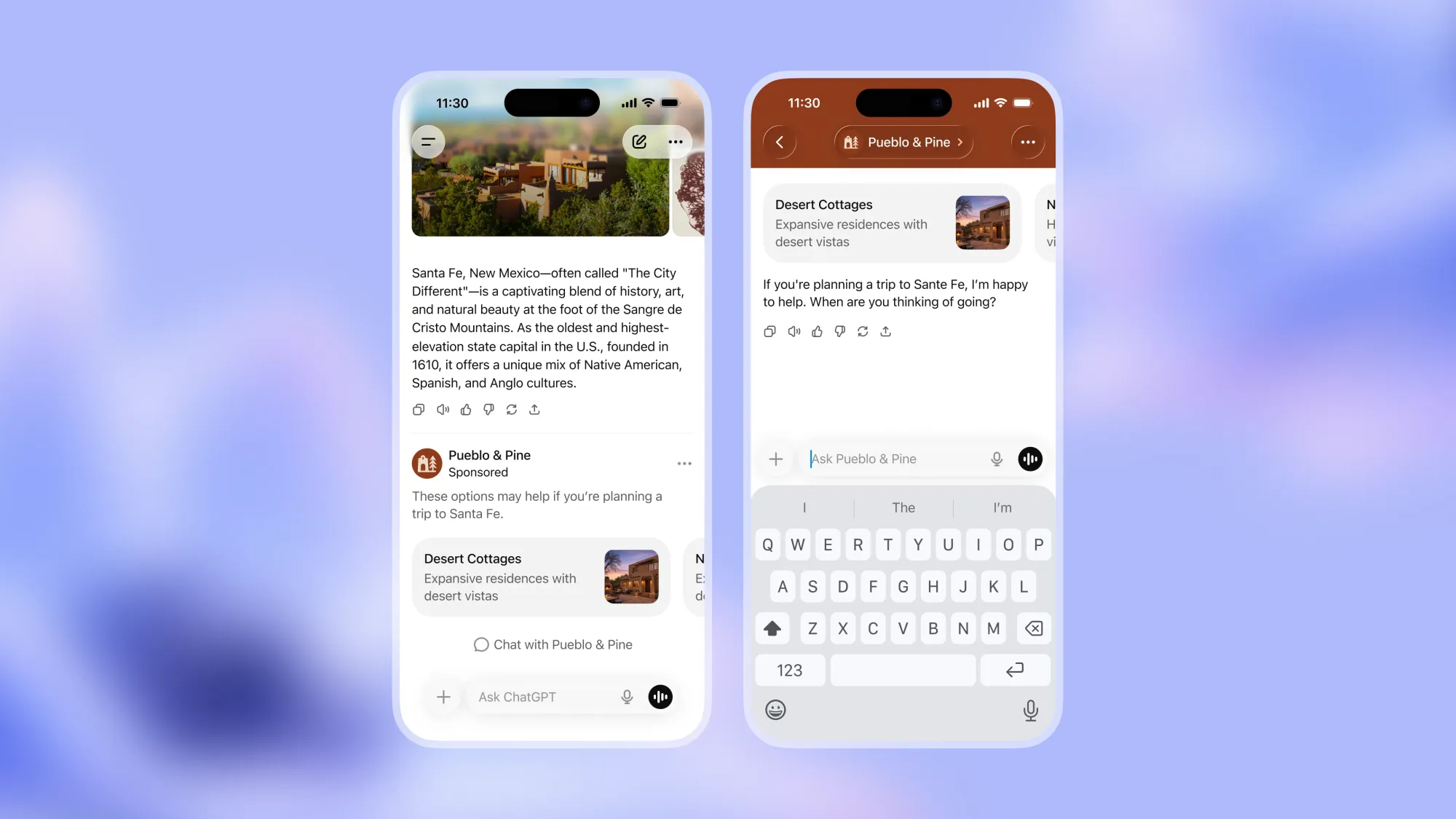
Anyway, anything with some sort of purchase intent is clearly going to get more click-inducing UI tweaks. This isn't necessarily a bad thing, but it will also help the advertising push. Yet it still feels like that won't be the big breakthrough here. And certainly it will never convert as Google Search ads have. I'm more intrigued by OpenAI's notion that you might want to chat with an ad. On the surface, this sounds gross, but it's perhaps a clever way to integrate ads more natively into the product. Want to know more about the iPhone's specs versus that Galaxy device? Maybe Apple pays to sponsor ChatGPT's answer (without any oversight of the response aside from insuring it's accurate?) with a link to buy. And maybe Samsung pays too for their own link, just in case you deem that the better path.
Travel. Tickets. Etc. The categories will undoubtedly be the same, but the key will be not destroying user trust in the chat by letting advertisers turn said chat into a giant advertisement. ChatGPT is saying all the right things now, but... such things have a way of morphing over time. Bending towards the arc of more monetization...
But all of the above is too obvious. The more interesting ads may be simply about information, the native content of ChatGPT. Can they figure out a way to get advertisers to pay to sponsor relevant information – again, not spammy/pitchy – in response to "regular" chats? Is there some sort of new "cost-per-information" model?3 Or if a user engages with it, "cost-per-interaction"? There obviously needs to be some sort of signal to showcase that it was useful to a user and again, it may not be a click. Otherwise, we're just back in the less interesting, and probably less useful, not to mention less lucrative, impression game.
Speaking of, Meta has historically played that game better because their breakthrough, the feed, is naturally more visual in nature. And the natural interaction there, the scroll, allows for easy ad insertion without annoying the user too much – if they don't like an ad, they just keep scrolling. But Meta, even more so than Google, at least in the early days, was able to leverage key knowledge about you thanks to their social graph. So while they didn't have the same search intent Google did, they had better targeting capabilities.
That's interesting as it relates to OpenAI because they should have sort of a hybrid of these two worlds and models (and, to be clear, Google undoubtedly knows more about you these days than Meta thanks to Gmail and Photos and Maps and everything else). ChatGPT can glean intent from what you type, but also better target ads based on all the knowledge it has about you from previous conversations. Google had this too with previous searches, but you're typing so much more, about so many more things, into ChatGPT than you would into a Search box.
Everyone – even Sam Altman – highlights how good Instagram ads are. It's obviously a combination of Meta's data and targeting mixed with the visual nature of that product. In a way, they're the new glossy magazine ads versus Google's ads which were more like old classified ads (on steroids, of course). Is there a way ChatGPT could leverage those types of ads too? Maybe if they continue to fully build out their image generation tools and can make it a true hub people visit. Meta is obviously trying to do this with their AI products. But it's not clear that will be a natural use behavior with AI content, we'll see.
Sora and AI video would be the next holy grail after that, of course. If OpenAI can break into the video advertising game – aka, commercials – well, that's another massive business opportunity. It's one YouTube is still in the process of siphoning away from TV, with TikTok and yes, Instagram pushing hard as well with some success. And then there's Netflix, Amazon, and everyone in streaming making their moves too.
But we're getting way ahead of ourselves here. First, OpenAI needs to find the right chat-based model for ads inside of ChatGPT. Again, it may be more similar to the Google Search model, but it won't be exactly like it, and new metrics will probably be needed to work at scale.
And there's a privacy angle, which OpenAI doesn't shy away from in their post, which makes it even more of a challenge. Many people are clearly already telling ChatGPT things that they don't necessarily want to be advertised against. And yet, an area like health is one of the most lucrative areas of advertising! So that's going to be a fine line to walk... For now, ChatGPT is probably wisely steering clear.
At the end of the day, OpenAI undoubtedly still wants to believe that they can have a more hybrid model than either Google or Meta have, in that they have millions of paying users from the get-go as they start this ads push – those other companies did not, at least not for the core products: search and social feeds. Can they take their existing model and layer in advertising, versus it consuming the entire product, ensuring "enshittification"? In that way, it's almost more like Netflix.
But again, the key will be finding the right mix of where/when to serve ads and what type of ads to serve. Oh, that's all? The company is confident enough to think that the business will bring in "low billions" this year, but can they do that without ruining the product experience? I think it's going to take thinking differently about ads.
1 Just ask Apple. ↩
2 Or, I guess, you could have an AI agent go do this for you, which every AI player is also rushing to enable. But this is more complicated, with major players like Amazon quickly moving to block such bots. Anyway, that's a different topic. Undoubtedly related, but still also in the future... ↩
3 And does this eventually complement a way to pay publishers/content producers for such information that is surfaced by ChatGPT? The one-off data deals also aren't scalable. ↩