
Apple Invents a Laptop with a Touchscreen
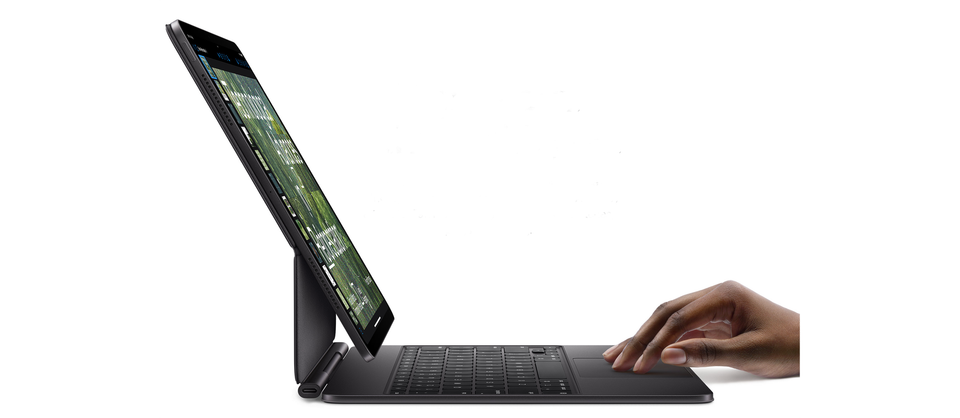
Men will literally make the thinnest, fastest touchscreen device ever and then give it a keyboard and trackpad and a landscape camera system instead of making a MacBook with a touchscreen...
To me, perhaps the most interesting element of Apple's "Let Loose" iPad event yesterday was an almost throw-away line. "Feels just like using a MacBook," John Ternus, Apple's SVP of Hardware Engineering, said of the trackpad on Apple's new Magic Keyboard accessory for the iPad Pro.
That's great. But it's also a weird thing for an Apple executive to say...
For years at this point we've been told that the iPad and MacBook are two distinct Apple products and never the two shall meet. But increasingly, the two have been meeting. Trading notes back and forth, as it were, as they continue to bleed into one device. Really only one thing holds the two sides from fully coming together at this point: a touchscreen.
And that may be changing as well at some point in the future, if reports are to be believed. But the reality is that Apple probably should have done this years ago.
As the years of using both devices go by, I find myself increasingly reaching up to touch my MacBook screen out of habit. And I grew up on PCs. My five year old simply doesn't understand that touching a MacBook screen does nothing. That's how computers work to her. Meaning, of course, the iPad.
So why has Apple waited so long? Well, first and foremost because Steve Jobs said so. Noting that touchscreens were "ergonomically terrible" at the launch of the iPad in 2010, he went on to say that: "Touch surfaces don't want to be vertical. It gives great demo but after a short period of time, you start to fatigue. And after an extended period of time, your arm wants to fall off. It doesn't work." And so Apple has gone out of their way in these past 14 years to ensure that they won't work on the Mac because they won't be included on the Mac.
Yes, Apple would have to do a bunch of work on the software side to make macOS touch-ready. But it's Apple. They have the resources and capabilities to do such things. And actually, what I really want first is something they can do right now, if they choose to: the ability to let your iPad Pro dual boot iPadOS and macOS. Even before the touchscreen conversion, if you have a Magic Keyboard attached, just let me use the iPad as if it's the non-touchscreen monitor of a MacBook.
But Apple won't do this because it not only blurs but basically erases the line between the iPad and the Mac. Users want this, Apple does not. Why? Again, legacy. These are two separate products, as told by Steve Jobs.
I feel like at a high level this has long been an issue for Apple – being wedded to the past. When I look at what's going on in Apple's ever-growing regulatory battles, it's the same story to me: Apple, and in this case, longtime SVP and now Fellow, Phil Schiller is absolutely locked into the notion that the App Store should run as it did when it started. As if the rules around it were handed down on stone tablets from Jobs atop the mountain. Nevermind that the world was a very different place in 2008. And nevermind that many of those rules come from humorous wrinkles in time that have nothing to do with apps, let alone smartphones. These are the rules! We must protect them. We must protect this house!
Apple would have benefitted long ago from changing with the times a bit more. And I suspect the regulatory heat would be considerably cooler today had they done so. Certainly they'd have more developers on their side in such fights, which feels critical. Instead, it's Apple's way or the highway. And again, that often means the Steve Jobs' way – even though the Apple co-founder passed away almost 13 years ago.
Today's Apple is stubborn. Perhaps because Jobs himself was famously stubborn. But he also had this great ability to change his mind. Perhaps the single greatest trait in business. Jobs could rail on something non-stop and dig in his heels while berating what he thought was a bad idea. And then, on a dime, he would change his mind. Perhaps taking the point of view of the person he was so adamantly arguing with. This must have been incredibly frustrating, but also, oddly, refreshing. Because what really matters is making the right call.
Upon returning to Apple in 1997, Jobs pulled perhaps the ultimate about-face: "We have to let go of this notion that for Apple to win, Microsoft has to lose." That was to set up the previously unthinkable but absolutely necessary move at the time: Microsoft investing in Apple. Again, what really matters is making the right call.
I worry that today's Apple is still living in the shadow of Jobs. It's hardly surprising given that he was both the founder and savior of the company. But it's likely exacerbated by the fact that most of the key core executives today are still from Jobs' era and lineage. Schiller. Jeff Williams. Eddy Cue. Greg Joswiak. Sabih Khan. Johny Srouj. Deirdre O’Brien. Craig Federighi. Even the star of yesterday's show, the relative fresh-faced (in terms of being forward-facing – and clearly being set up for bigger things) Ternus has been at Apple since 2001. And, of course, Tim Cook. That's 9 of the 12 executives who have been there since the Jobs era – a few of them there before Jobs came back!
To be clear, that's a strength in terms of continuity, experience, and institutional knowledge. But there are downsides. Especially under that shadow of one of the greatest entrepreneurs the world has ever known.
To his credit, Jobs famously told Cook, "Never ask what I would do. Just do what's right." I believe Cook believes he's doing this. But I also believe what Cook thinks is right is too often what Jobs thought was right before Jobs would change his mind and actually do what was right. And I think Schiller and several other executives have fallen victim to this as well.
A decade ago, another leader took the helm of one of the tech behemoths by throwing out legacy baggage that was holding the company back: Satya Nadella. In his first public appearance, he announced Microsoft Office for iPad – something which, yes, had been in the works for years, but the company was perhaps reluctant to put out there because of well, legacy.
What I'd love to see from Apple as we enter the mid-2020s is a company that goes against its previous grain from time to time. Not in its fundamental values – they have Apple University for that – but in the ability to pivot from dug-in stances when the situation on the ground changes.
Let us run macOS on the iPad. Then launch a touchscreen Mac. Hell, merge the two devices. Change the App Store rules to suit the 2020s. Question everything. Kill your darlings. That feels like what Steve Jobs would do.
Thanks for reading, if you enjoyed this, perhaps:
🍺 Buy Me a Pint
🍺🍺 Buy Me 2 Pints (a month)
🍻 Buy Me 20 Pints (a year)