With AI, Email May Actually Morph Into a Task List
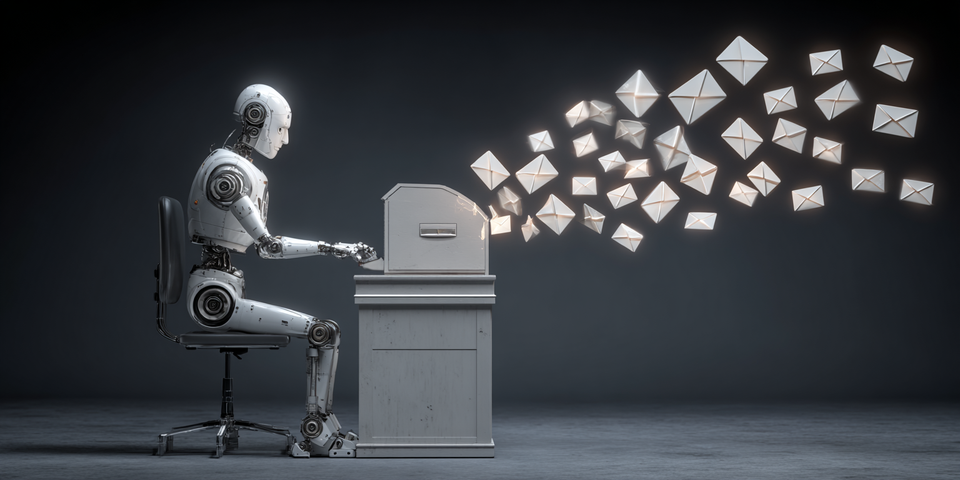
For a lot of people, the way they're first interacting with AI may be a technology as old as time – well, internet time: email. Between Google, Yahoo, Microsoft, and a bunch of other players, AI's tentacles are creeping into our inboxes. You don't need to use a chatbot, it's right there, perhaps summarizing long emails, or at the very least, prompting you to let their bots complete that sentence you're typing. Even the company sort of comically behind in AI at the moment, Apple, now has all of this stuff.
We're not going back. Which got me thinking about how this actually plays out...
As regular readers of mine from over many years will know, I hate email with a passion. So naturally I became a reporter, where the job is like 80% email. And then I became a VC, there the job is like 90% email. I'm sorry, but my only release valve is to write about email from time to time – if nothing else, as an excuse to not actually do email.
Email started as something almost akin to magic. You could send a note to someone, anywhere in the world, almost instantly. In those earlier days, it was not only not a burden to get an email, it was an absolute joy. People couldn't wait – myself included – to sit through a few minutes of dial-up modems whizzing and whurring in order to check their inboxes. On an individual basis, most of the email you get is still fine – aside from perhaps all the marketing – but the sheer volume has destroyed the magic for all of us now. That strength – that you could send a note to someone, anywhere in the world – became its weakness at scale.
Enter AI. Again, all of the companies with email products are now rushing to integrate tools to help tackle that overload problem. They're generally fine right now, but are getting better just as the underlying AI technology is improving at a rapid clip. As Google showcased at I/O last week, we're getting to the point where Gmail can write an email just as you yourself might, after studying your entire inbox (and outbox and Drive) in about 30 seconds.
The problem there is that you still need to actually read over that email before you send it. Previously, you had to do this because you wanted to be sure it would be accurate and not sending out some strange hallucination. But as that fear fades, you more so need to read it over to actually know what you're saying to someone. For yourself, if nothing else! And that is still rather tedious and sort of eliminates the whole point. And now I'm thinking the way this circle squares is an old post I wrote partially in jest.
Ten years ago, I wrote 'Bots Thanking Bots', riffing off the idea that Facebook was allowing you to let their (at the time, very rudimentary) bots wish your friends "happy birthday" on your behalf:
Which leads to the next question: at what point do bots start talking to bots? You know, why should you have to type “thank you!” when you can reply to a text with “1”? Or better yet, why should you have to type the “1” at all? If Facebook knows you want to say “thank you” to everyone (bots included) who wished you a happy birthday, shouldn’t they just give you the option to let Facebook do that for you on your behalf?
And that leads to the notion of having Facebook automatically say “happy birthday” to a friend on their birthday each year. If you can do that and then the Facebook “thank you” bot can reply to the “happy birthday” bot, we would have some hot bot-on-bot action.
We’re just now getting used to the first layer of interacting with bots for various services. But having bots chat with other bots is the next logical step that probably isn’t that far off. In many ways, it may be easier to make happen because it removes the flawed human variable in the equation. I’m both kidding and entirely not kidding.
Moving this concept over to email, if AI can write your email and read your email, it's easy now to joke that in many jobs, such as the ones I've done in my career, you could just go on vacation. Of course, you couldn't really do that for the same reason as mentioned above: at some point, someone – a human – has to be in the loop about something. I mean, honestly, for a lot of email back-and-forths, probably not – but for some, there are real-world tasks to be completed. By someone. One day, bots – robots – may be able to handle those too. But in the more immediate future, I think this looks more like emails being distilled into actual action items.
Yes, your inbox will go from being a de-facto to-do list (generated by someone else), to an actual to-do list (generated by your AI).
To some, this will sound like absolute hell. But I suspect it may lead to actual productivity gains for most people because again, the scaling of the email inbox has become untenable. Boiling email down to its essence could work.
To others, this will sound downright dystopian. We're taking human-written email and turning it into bulleted action items generated by AI. But again, it feels inevitable. And, in many ways, needed.
Oddly, it may lead to a world in which letters – old school letters – make a comeback. I've long been of the notion that I think one of the second order effects of AI is that human-made creations will increase in value, and we might see something along these lines with handwritten notes.
Yes, this may lead to a new sub-economy where people are paid to write these personalized notes a la Theodore Twombly in Her. Yes, this is a Her reference without mentioning Samantha. Until now. Damnit.
Anyway, the point is that I can see a world where AI actually does lead to the end of email, in a way. It won't eliminate it, but it could eliminate your need to do it. Or, at the very least, cut back on it quite a bit because it will be abstracted into an AI layer above it, where you talk to your AI assistant about tasks and to-dos. Sure, you'll still be able to send it, but it will be more like disengaging the autopilot to fly manually. For most things, it will become something the bots do on your behalf.
And this antiquated technology could become the ultimate fallback for "agentic" communication when various newer protocols don't align for whatever reason. In many ways, email already is that fallback for many things today. Being the cockroach of the internet has some advantages...
One more thing: about a year after the post cited above, I wrote another post – publishing my thoughts sent to a publication which was asking for my opinion on the current "bot" hype cycle – in 2016. As you can read, I wrote that it was way too early for any of this to work right now, let alone for companies to be built around them, but if and when some of the AI/ML stuff started to work...
 M.G. Siegler

 M.G. Siegler

 M.G. Siegler