
Amazon Phones Home
There's something that has long annoyed me about the way Panos Panay answers questions. This dates to his Microsoft days and continues into his Amazon days. He often does this thing where he tries to turn the table on the questioner by acknowledging what they're getting at, trying to seem like he's being direct, but it's really just a form of misdirection. I'd find it decidedly less disingenuous to simply give an "I'm not going to answer that" – you know, the Apple way.
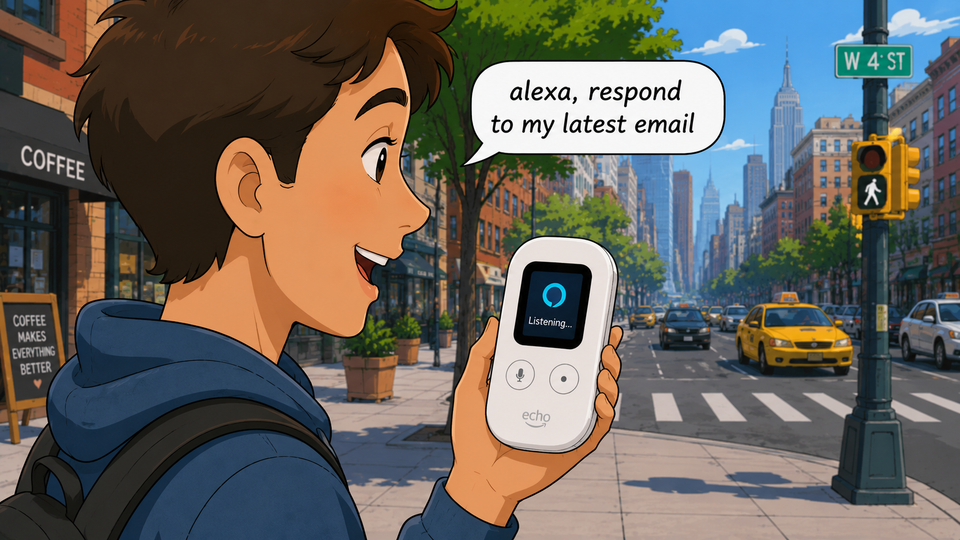
Anyway, this long FT interview seemingly almost lulls Panay into giving an actual answer. Not quite, but he seemingly reveals enough that's interesting. I speak, specifically, about "Transformer", the codename of Amazon's rumored new "phone" project. After Panay dances around the notion of new devices and form-factors that Amazon is thinking about and/or playing around with internally (which, as he notes, sometimes leads to "rumors"), Rafe Rosner-Uddin comes right at him:
What sort of device will you come forward with? Will it be a phone? And will people sacrifice their iPhone for an Amazon phone? Is that a surface area that you even want to play in given how competitive it is? Amazon’s Fire phone wasn’t a success and you tried to bring mobile back at Microsoft with the Surface Duo.
At first, Panay tries to pump the brakes with his verbal roundabouts, but then he sort of stumbles into perhaps revealing something by trying not to directly answer the question:
Here’s what I’d say: it’s just not the goal. I know there’s a lot of rumours out there.
I don’t think the phone form factor is going away anytime soon. I’ve said that publicly. I keep saying it. I always get asked, ‘so the phone’s gone, right?’ Absolutely not. The phone’s not going anywhere. However, I think the phone is going through some transformation, and will continue to do so over the next 10 years, for sure.
I think your black and white question is, are you going after a phone? A lot of people want me to say no, but a lot of people want me to say yes, I get it. Here’s my take: it’s not necessarily [that] we’re going after a phone, no.
There’s no clear path that makes sense. You just said it, there’s so many new form factors that are important that need to be focused on. It’s a tricky question. If I black and white say no, I would say that was accurate. But I also think it’s misleading.
There's a seemingly fairly easy way to read between those many lines: Amazon is not working on a device that looks exactly like the iPhone or the latest smartphones from Samsung or Google, but they are perhaps exploring devices that would essentially fill that role (and hole) in your life.
It's all a bit silly. Is the iPhone really a phone? I mean, technically yes, but that specific functionality is arguably the least interesting aspect of the device. It's really just a computer. For the past 15 years running, the most portable computer. As a result, this has made it the main hub of both our computing lives, but also arguably and increasingly our lives in general. That hub status is what Amazon – and everyone else – would clearly love to capture. Who cares if it's a phone?
As Panay notes, there's really no obvious inroad to disrupt the iPhone at the moment. As it turned out, there also wasn't back when Amazon shipped the Fire Phone or when Facebook went down the phone path as well. Microsoft too under Panay!
As he continues:
One of the most incredible parts of the culture here is the willingness to make a big bet when you need to. And the question is, when do you need to? Well, what’s the right thing for the customer over time? There’s always opportunity, but right now, no.
What I won’t ever do again is [go to the customer and say] here’s another phone. What do you think? There’s no point. We know what customers need right now.
That might suggest that Amazon will come at consumers first with a tangential device – or devices. Things that perhaps work with the current crop of phones. This makes sense and it's seemingly the same gameplan that OpenAI is exploring with their Jony Ive-led device – or devices. Meta as well because again, they don't have a phone, so what choice do they have? But all of these players, assuming they see some level of success with any sort of newfangled AI-first devices – far from a given, obviously – will almost necessarily want to break free from the chains of Apple (or Samsung, Google, etc).
That's undoubtedly why Panay doesn't want to full-on reject the notion. Amazon may indeed come out with something that may not look exactly like the iPhone, but will serve largely the same purpose. Again, a hub for your computing life.
Panay notes a few times in the interview that right now he views the home as such a hub. And that's obviously because that's where Amazon has a foothold thanks to millions of Alexa devices sold over the years. With many (but not all) of those now (finally) being upgraded to Alexa+, this is a potential strength for Amazon, certainly versus Apple, which has a far smaller footprint with the HomePod, and their latest attempts to enter the home have been delayed along with the revamped Siri.1
So can Amazon figure out a way to bridge the home to mobile? Maybe. And as Rosner-Uddin smartly follows up with, perhaps it's Amazon Leo, their newly rebranded but still not operational satellite internet project aimed to compete with Starlink. If Amazon can turn that effort into a true consumer-scale offering, the sky is quite literally the limit. That suddenly flips them from being beholden to Apple to Apple potentially being beholden to them – they already are, in a small way now thanks to Amazon's GlobalStar deal!
Anyway, yeah, sure, Amazon is not building a phone. But they're also not not building a phone. Because it may not be a phone as we've typically thought of a phone. But the phones we now have are long from being thought of typically as phones. They'll probably start with devices that work with existing computing hubs – i.e. the iPhone – but they'll eventually aim to create something that can become that hub itself. Perhaps connected via their own satellite service.
 M.G. Siegler
 M.G. Siegler
 M.G. Siegler
1 Just as Amazon had to delay Alexa+ before rebooting the efforts – something Panay talks a bit about, but is also clearly disingenuous about with "I don’t know if it was already really in flight." Come on... ↩