
The Age of the “Super App” — Again and Again and Again
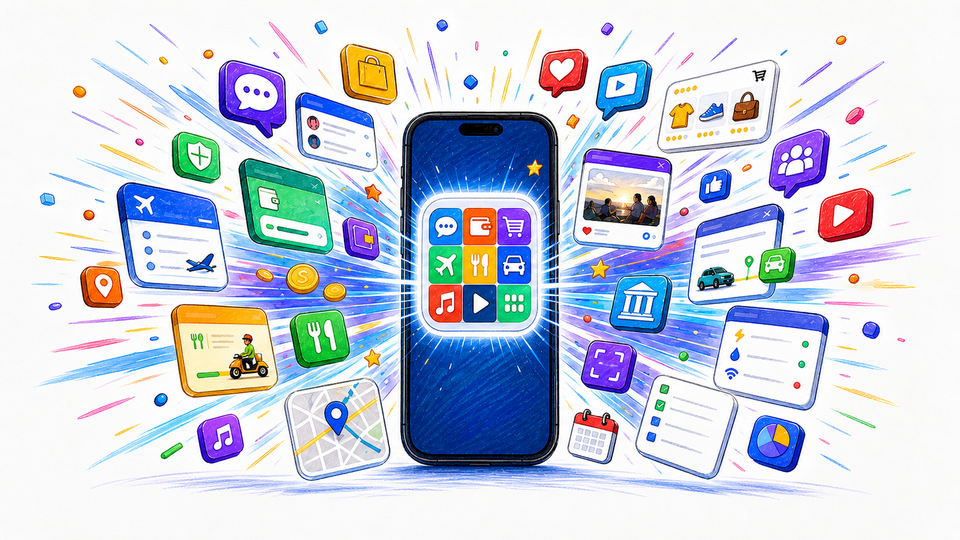
It's a story as old as time. Or at least as old as tech. As a company finds success, especially in mobile, they tend to expand outwards. That is, with more apps. And that inevitably leads to a move to consolidate all the disparate services back together into one "Super App".
Meta is probably the most famous example of this trend, because they've tried to do it a number of times, dating back to when they were still known as Facebook. The company would constantly bundle and unbundle services like Messenger and Photos. I mean, even Poke was unbundled at one point. This expanded beyond Facebook with WhatsApp becoming another attempt to create one-app-to-rule-them all after Mark Zuckerberg clearly saw the success of the "super apps" in various Asian markets with products such as China’s WeChat, Japan’s Line, and South Korea’s KakaoTalk. But it never really worked. Or at least, hasn't yet.
But if at first you don't succeed...
Beyond Meta's continued efforts to bundle and unbundle – most recently with AI – the latest wave of attempts at "super apps" was undoubtedly kicked off by Elon Musk. Back in 2022 he gave his rationale for buying Twitter as such: "Buying Twitter is an accelerant to creating X, the everything app." Well, Twitter is now long gone, in its place is, in fact, X. So how's it going?
Perhaps well if you consider reverse mergers as a path to such a "super app". X, of course became a part of xAI, Musk's attempt to compete with his previous company, OpenAI, which quickly grew larger than X itself – at least from a valuation standpoint. But that merger also accelerated the losses of the company so they'd either need to raise money in perpetuity like the other frontier AI startups or... be subsumed by another entity. Enter SpaceX. And while you can't yet use X, the app, to launch rockets into space. It's perhaps just a matter of time.
But really, Musk has continued to push towards the "everything app" idea with the recent launch of XChat. And soon, 'X Money'.1 Never mind that these are separate, stand-alone apps at the moment. They obvious exist to eventually bundled back into that proverbial "super app". And depending on how the SpaceX IPO goes, the "vibe coding" service Cursor, may not be far behind from becoming a part of the playbook. And one day, of course, Tesla.
Can all of those services reasonably exist inside one app? Probably not. But that won't stop the powers that be from trying!
The "super app" trend is clearly hitting a fever pitch at this point. While Coinbase jumped on the trend several months back, fellow YC company Airbnb has also been pushing on the notion for some time. Beyond rolling "experiences" into their app, now they're going to add direct access to ride-sharing services and yes, hotels too.
Uber, meanwhile, has been at such "super app" ambitions for a while. You could argue that Uber Eats itself is a part of this, but more recently, they've been coming after the same goal as Airbnb just from the opposite angle, adding an increasing array of tangential services to their ride-hailing app. The most recent push to become a "super app" involves a partnership with CEO Dara Khosrowshahi's old company (and oft-cited acquisition target) Expedia.
Snap, perhaps in part due to their investment from Tencent, owners of WeChat, and perhaps in part due to their ownership of their demographic, was trying to build a "super app" years ago. More recently, Spotify has been trying to break the bounds of bad music margins with podcasts, books, and now a range of partnerships.
Back in the land of AI, perhaps you're aware that OpenAI is on the verge of their own "super app". This will include not just ChatGPT but also their vibe coding solution Codex and even their web browser, Atlas. This follows competitive pressure from Anthropic, as Claude currently houses not only the chatbot, but Claude Code and Claude Cowork as well in one package on the desktop.
Google, meanwhile, just launched their first stand-alone AI app for Gemini on the Mac. This obviously signals new coding and agentic tools on the way which will be bundled into the app. This is the way.
Speaking of, guess who else is now talking about the notion of a "super app"? Disney! That's right, the entertainment company is also exploring ways to put the true "plus" in Disney+ under new CEO Josh D'Amaro. What might such an app include? "A place where users can book park tickets, buy merchandise, play games and watch movies," according to Thomas Buckley and Lucas Shaw's sources at Bloomberg.
This isn't too surprising given that D'Amaro previously ran the Parks division for Disney and has been the steward of their investment in Epic Games. But the company has also discussed trying to make such a "one stop shop" for all things Disney in the past, and it hasn't gone anywhere.
In fact, outside of the aforementioned Asian markets with their handful of dominant players, the model just has not translated to the Western world. It's unclear why this time will be different – maybe the AI services like Claude making cross-pollination more the norm, maybe? – and there are plenty or reasons to think that it won't be.
The most obvious issue, as I talked about with the notion of OpenAI's "super app" is one of complexity. Apps, against, at least in Western markets, have historically been fairly focused and simple. Uber. Airbnb. Twitter. These are apps to do one thing. But the desire to expand is always there, lingering. And the business dictates it. So the simple naturally becomes more complex.
This is even more pronounced if you try to mix business with pleasure, as it were. Say by trying to turn a consumer hit service into an enterprise one as well. These things tend to happen naturally, or not at all.
The risk, of course, is user experience. One reason Facebook has had to keep unbundling after pushing to bundle is bloat. When your service starts to require multiple menus and drop-downs – congrats, you've created Microsoft Office. That might be fine for business, but for consumers, it's a nightmare. That's the reason why OpenAI had to simplify ChatGPT's drop-downs – it was a total mess.
There's undoubtedly a balance to strike. And Netflix may point to a way forward here, as they've been able to keep the app pretty streamlined even as they shove more and more stuff into it. Not just more content, but more types of content. Like sports and even games. They still rely on their algorithms to serve up what they think you'll want on that all-important main page.2
Dynamically served-up interfaces could be a key to making this work.3 And AI will obviously be a key to that. Or the "super apps" may fail to catch on, at least in the West, for the 20th year in a row...
 M.G. Siegler
 M.G. Siegler
 M.G. Siegler
1 If we're reallying going to do the 'X ____' branding, can we at least standardize how they're styled? Should there be a space after the 'X' or not? Might I suggest a lowercase usage since 'xChat' and 'xMoney' looks at least a little less porn-y? Also, sort of calls back to Apple's success with their famous lowercase 'i'... ↩
2 Though I'd still argue that they push their games a bit too much. ↩
3 Elon/X would undoubtedly argue that payments are the key to make this all work, and there may be something to that notion. Though I'm not sure how easy it will be to get people to route payments through an app like X... ↩