
Pushing or Pacing or Pulling Back From the AI Frontier?
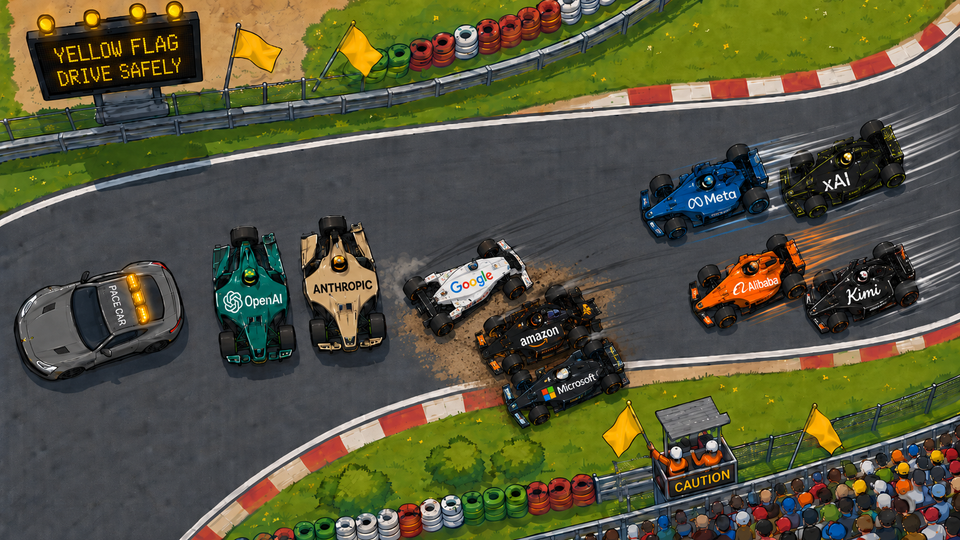
This is a strange moment in time for AI. I mean, things are always sort of strange simply given the breakneck speed at which the technology is evolving. But that's the thing about right now: we're sort of paused? At least at the all-important frontier.
We're used to a race. The various parties racing don't like to frame it that way publicly, but come on. It's a race. To AGI. Or RSI. For talent. Or the best models. Or to the models that simply score best on various tests. But in the past few weeks, it almost seems like it's more of a caution flag situation, to extend the metaphor. When the yellow flag is out in an F1 race, drivers must slow down and get behind a safety car. No overtaking is allowed. All drivers adhere to this for the integrity of the race – and so no one gets killed in moments of uncertainty...
It's not a perfect analogy, first and foremost because there are no formal agreements to pause or slow down in AI at the moment. But there are potential structures in the works which would effectively do that, most notably the White House's plan to vet models at the frontier before they're widely released. Then there's the regulatory framework first proposed by DeepMind's Demis Hassabis, which other AI leaders have endorsed to create a standards body to test frontier models across the industry.
There's also the notion of "pacing the frontier". That is, calls being made by some of the leading labs – or at least some employees at those labs – to slow down AI development. Pacing, you know, like a pace car, leading us right back to the racing analogy.
So yeah, the "caution flags" are seemingly in the works, but right now it's much more ad-hoc. This started, of course, with Anthropic's Mythos models, which broke new ground when it came to security (and the inverse). But then even carefully vetted (or supposedly contained) models started to hack up the real world. And all of this is – undoubtedly rightfully – making the leading AI labs trigger shy when it comes to continuing to push the frontier. Both Anthropic and OpenAI have held – or are currently holding – models back. And OpenAI is even now noting that they're pausing development on such models as they work through potential broader misalignment issues.
The word they use? "Pacing".
Cynics will say this is an attempt to pull up the drawbridge. Or perhaps a way for the frontier labs to slow some wildly out of control spend as they yes, race, to go public. Or maybe they're simply out of compute capacity. But there's also a reality where these labs really just don't like what they're seeing on the frontier. Perhaps because they're afraid that they're on the cusp of no longer being able to control it.
Regardless, again, it's a weird time! Potentially a terrifying one. But also potentially not. But beyond the Big AI labs, there's also weirdness in the way that Big Tech is now looking at the AI frontier.
The CEOs of both Microsoft and Amazon have now made public comments about being okay with others taking the lead in that frontier. Sure, that's easier to say when you happen to be massive investors in those would-be leaders, as both Microsoft and Amazon are with both Anthropic and OpenAI (not even respectively, just both are big investors in both!). But it's also weird because both Microsoft and Amazon have teams still seemingly trying to build frontier models!
Again, perhaps easy to say you don't care about the frontier when you're not actually at the frontier, but the mindset certainly seems to be shifting towards a more hybrid – dare I say "open" – approach to AI. Microsoft and Amazon simply want to be the routers to the right models at the right time. Sure, some may be their own, but only because it will help with price. This all seems largely about reading the room with regard to cost (and compute) complaints across the board.
So it's a question of if this is a moment-in-time thing or if going forward the frontier will matter less than simply having a capable-enough model at a reasonable price. Again, Amazon and Microsoft will point out that they have frontier access thanks to Anthropic and OpenAI. But that's definitely discounting the notion that the AI frontier could still be what matters most, as has effectively been the case to date. Hence, the race!
Because if that was still the case, Amazon and Microsoft would certainly want to control their own destinies by owning that frontier, lest they be beholden to others, investments (and contracts) or not. And again, they say they are still working towards that frontier, but clearly not with the vigor that others have been.
Others, like Google. Which famously got caught flat-footed when the AI race first kicked off in earnest – despite what should have been a years-long head start, having developed the underlying LLM technologies and concepts in-house. Still after some initial stumbles out of the gate, they were able to get back in the race. Perhaps even to the front of it by some measures. To the point where some were worried that it was over. That Google was pulling away.
Somehow, Google fell behind again. Was it internal politics? A lack of focus? A focus on other elements of AI? Probably all of the above to some extent, but a new shakeup has many asking questions about their road ahead here. Are they actually giving up on the frontier? Perhaps even more so than Amazon and Microsoft? Or will new leadership actually double down?
It's not yet clear. Google will undoubtedly say, like Microsoft and Amazon, that they want to do it all. But can they? Compute constraints aside, the security pauses at Anthropic and OpenAI have to give them some pause as well here. Does Google really want more regulatory headaches? Particularly if their most obvious way to win is through distribution on their other billion-user platforms?
All of this could just lead right back to antitrust court. Why not, say, take a turn to focus on "world models", as Hassabis seemingly has been focused on with DeepMind of late? Because Google should own agentic coding? Maybe if you believe – as Sergey Brin might – that it leads to RSI/AGI. But it's not clear that this mindset isn't already shifting...
Though not at Meta! After also famously falling behind in the initial race, riding a llama that wasn't quite fast or strong enough due, perhaps, to some "open" issues at the time, they're now back in it too. Or apparently will be soon enough if/when we see their "Watermelon" Muse model.
Why spend hundreds of billions while Wall Street vomits all over your stock? Because Mark Zuckerberg also doesn't want to be beholden to anyone else when it comes to core technology. He made this mistake with Apple, he's not about to do it again, costs be damned.
Also, Meta might need a new model. As in business model, sooner rather than later. To win in AI, they're clearly willing to undercut competition and even "open" up again if there's opportunity there.
So Meta is still racing even while the others are paused, or slowing development. As is SpaceXAI, the artist formerly known as xAI, which was last seen also falling behind despite billions spent. But money aside, what may actually work is the complete rebooting of the teams (by spending billions), which both did.
Obviously, there are a number of startups trying to still race towards the frontier of AI too. Or to reset it, as most of them are trying other approaches since they don't have the Meta or SpaceX billions to burn.
Meanwhile, in China, the situation may be even more complicated. A year after the "DeepSeek Moment" served as a wake up call for the US players but didn't push any of the Chinese models to the frontier, a new "Kimi K3 Moment" may have propelled them much closer.
And China's own sub-race is certainly propelling at least downloads of their "open" models to new heights. How much that matters... again, tbd. If nothing else, the Chinese models are exerting extreme cost pressure on the leading US models. But it's also to the point where it's clearly not sustainable for them either.
Can one of the Chinese models actually get to the AI frontier? ByteDance is apparently trying by training a model with 10 trillion parameters. That's not only three times larger than any other Chinese model, it's thought to be bigger than the aforementioned mythical Mythos.
This previously seemed unlikely if not impossible without the full access to the most powerful NVIDIA chips, but, uh, AI is seemingly finding a way. And again, the US frontier pause/slowdown could obviously help China here.
Then again, we may end up seeing just how much distillation matters in that regard – i.e. if the US frontier slows down, it stands to reason that Chinese model makers going full-speed would surpass the current frontier, unless those models rely (even just to a degree) on those US models to help train them... That same report has a source saying that ByteDance is not relying upon distillation for this mega model. So... we'll see!
It's a weird moment in time. Especially because it's not clear where we go from here. With some level of regulation/oversight in place, do the US companies rev their engines again to race towards AGI thinking they have a safety net? Or is it not actually a safety net but just a mild impediment for models soon to be powered by RSI to get around? Or do things actually slow down further because of increasing security concerns? And if so, can we convince China to slow down too? Or do costs and compute constraints naturally continue to slow everything down? Or do new breakthroughs come that negate such concerns? It all seems possible as we ponder during this pacing.
"I think it is a good time to slow down."
– Sam Altman