
Meta's Open Weight Whiplash
I'm old enough to remember the last time Mark Zuckerberg was embracing "open" as the future of AI. Which is to say, I'm at least two years old.
A lot has changed since the last time Meta released an open weight model – namely, seemingly the entire team building models for Meta. Famously, "Llama" was put out to pasture as Alexandr Wang and his Scale team was brought in to fix what ailed those previous models. That included not only spending billions on fresh AI talent and data centers, but also setting aside that notion of "open" in favor of a closed approach to AI development. Why? Because it sure seemed like that model – and those models – had won the day just over a year ago.
To hear Meta tell it – as I'm sure we're about to endlessly – the company never left "open" behind, they simply did what they needed to do in order to reset their efforts and catch up, fast. And there's undoubtedly some truth to that, but also some gaslighting. If OpenAI and Anthropic were still running away with the AI game – or if Meta was in the lead – we probably wouldn't be hearing too much about "open" right now. But again, a lot has changed in the past year.
Most notably, OpenAI slipped and fell behind their chief rival Anthropic. And Anthropic, in turn, has kept trying to commit seppuku to sacrifice themselves at the hands of an angry Trump administration. This, mixed with their new frontrunner status has led to an inevitable backlash against Anthropic, even though they mostly maintain their lead in models and in the all-important coding category.
But the real key was China seemingly catching up to that frontier of AI. Not quite, but perhaps close enough – closer than DeepSeek 18 months ago, and with AI in a more mature state, being "close enough" perhaps matters more now. And that's especially true given the cost and consumption concerns that a lot of corporate America is feeling at the moment with regard to AI. If those Chinese AI models are "close enough" at a fraction of the cost of the frontier models...
And while it may sound crazy to think that American companies would willingly use Chinese AI models in a time when the current administration has made it clear that China is the US's techno enemy #1, China left a door open to blur such lines with the focus on yes, open weight models.
If anyone can download these models and host them elsewhere – including on the clouds of the Big Tech players in the US – what's the problem? I mean, there are potential problems in that no one knows exactly what went into these models to train them as they're not actually "open source", as that's not the same thing as "open weight" despite what op-eds and New York Times headlines (see below) would have you believe. Still, much as was the case with the "DeepSeek Moment", I'm not sure how much the Chinese models will end up mattering in the end – as they're already tweaking their terms and models in showcasing why "open" here very much deserves the quotes – versus what the rise of such models point to.
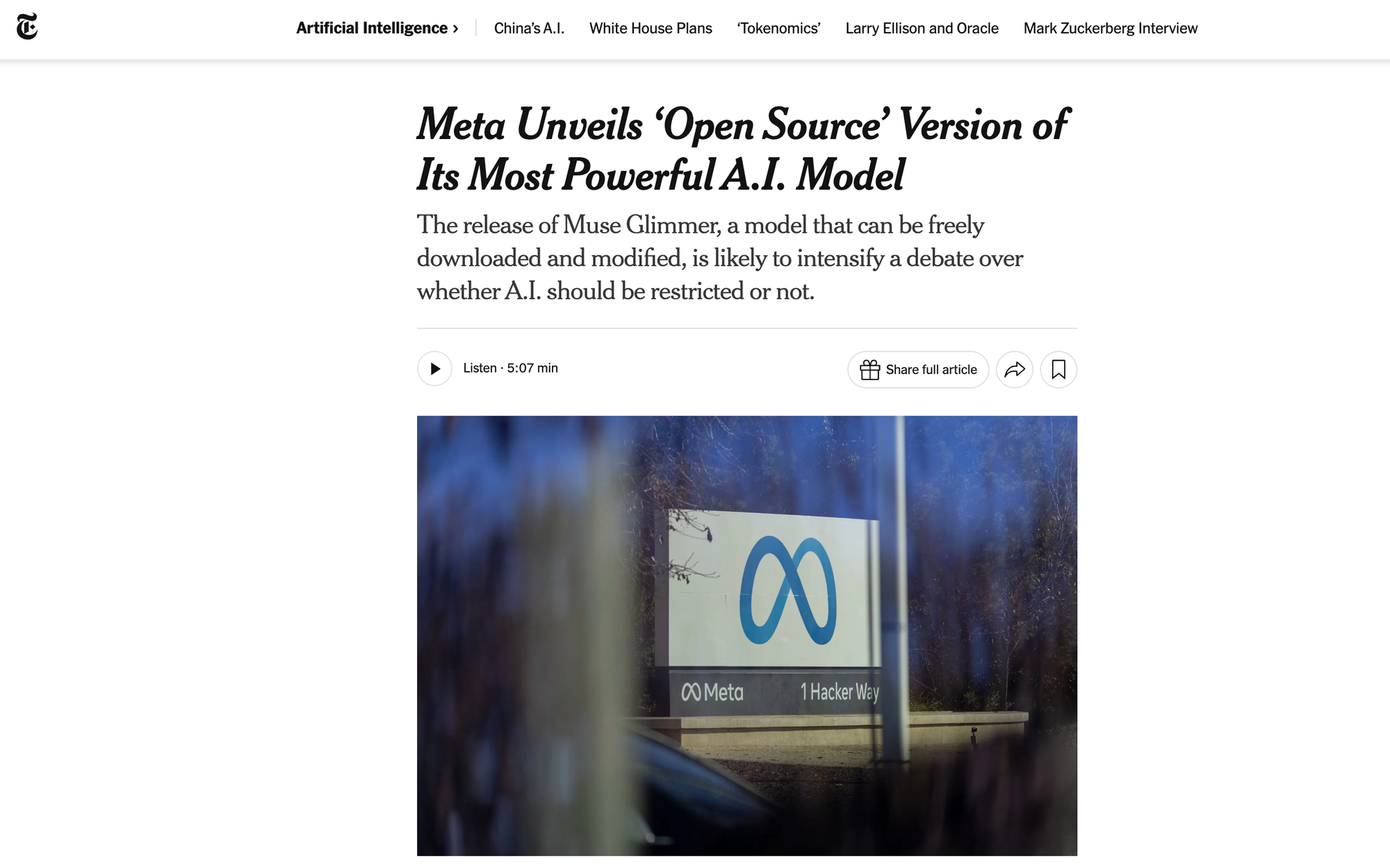
That is: open weight models may now be a viable alternative to the closed variety and, relatedly, distillation of such models may actually spur innovation in the sector.
That's why we saw hundreds of US companies sign on to a letter to help ensure that the US government didn't destroy this "open" path in their attempts to slow down China. Obviously, the initial batch of companies that signed on, from NVIDIA on down, were conflicted with such ideals. But it created the intended groundswell to seemingly both get the government to heel but also pressure current "closed" AI leads like OpenAI and Google to sign on.
Yes, yes, both offer "open" models too, but only far less powerful varieties, released months after their frontier models. That is not what China is doing. And none of this is what Anthropic wants to become the norm. (They still refuse to sign the letter despite the pressure because they say while they're generally okay with open models to some extent, they're worried about the safety and security implications and ramifications if the frontier goes open weight. Which many read as the company protecting their moat. But others note that this is likely what the company actually believes.)
Anyway, that's a long-winded way – though about 1/10th as long as Mark Zuckerberg's new "essay" on the topic – of saying that Meta is back in the "open" game. Again, a game they'll say they never left, but they really did. And that actually may have been a mistake, as I noted a few weeks back. But it's also probably not too late to correct as the US "open" model race still feels wide open. And without Anthropic, OpenAI, or even Google fully committing to it (again, at the frontier), Meta may have an opening here.
And they're taking it.
To be clear, 'Muse Glimmer' is not at the frontier. Hell, it's not even at the frontier of Meta's own current model offerings – meaning, Muse Spark 1.2, which is by most accounts a very good, but not frontier-level model. They note that Muse Spark 1.2 will also get its weights released at some point soon, but again, Glimmer is not that. Which suggests that, as expected, Meta is going to follow the new general "open" playbook, at least in the US. That is, release a model, and once it's out there in the wild for a while, then you can "open" it up.
Why they didn't just wait to do this with Muse Spark if it really is that close to being "open" too, I don't know. But it seems like they aim for Glimmer to be smaller, to the point where it can run locally on some machines.
The real key will be what happens when Meta releases their actual frontier model, the one codenamed 'Watermelon', which many expect to be both coming soon and also competitive with said frontier. Will that too be "opened" up at some point shortly after launch? Meta isn't saying, but also, to be fair, they're not saying anything about 'Watermelon' beyond nebulously alluding to it. Because it's not actually out there yet. And talking about models before they're ready has gotten Meta in trouble before – see: Llama 'Behemoth' which no one ever did end up actually seeing in the wild.
My guess would be that if 'Watermelon' really is as good as the current frontier, the weights won't be released but it will instead be used to distill some other Muse variant that Meta will release as an "open" model... We'll see!
Regardless, it's clear that Meta, and Zuck in particular, are slamming on the gas. That's why you get a 7,000-word essay just a couple weeks after writing a decidedly more parseable version as an op-ed in The Wall Street Journal. This memo is verbatim to that at many points. So this is like the "Director's Cut" I guess. Boy does it need an editor...
Meta clearly sees "open" as a new opening here, which, yes, is ironic given that it was their initial path. But they also see openings in consumer/personal AI, especially with OpenAI seemingly taking their eye off that ball in their fight with Anthropic. As well as an opening on the business model front, where margins are always opportunities. Still unclear: can Meta make any of this pay off this time? They seemingly have more options now, but this is all completely unproven for them...
Zuck also clearly sees an opening around the messaging of AI. He wants Meta to hold the "positive AI" position. That's going to be easier said than done, quite literally. But yes, "open" is a part of that messaging. So "open" is back! No llamas this time though, sadly.