
My Boy's Wicked Smart on AI
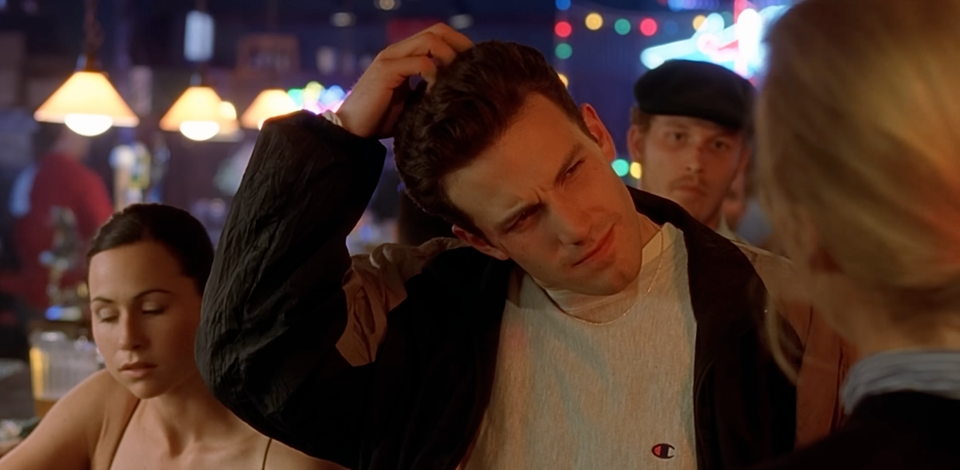
Wait a minute. You mean to tell me that Chuckie Sullivan might be Will Hunting when it comes to AI? I mean, can we just dive a bit into Ben Affleck's comments on The Joe Rogan Experience – I know, I know! – last week?
Rogan tees up the question around films potentially being written by AI – "it gets weird, right?" To which Matt Damon defers to Affleck as "an area of expertise for him." Okay, I'm intrigued, let's see what you got, Ben!
After a comparison to electricity – not the worst analogy, one that others have used in talking points before,1 though not particularly useful here, we get to the goods:
What I see is if, for example, you try to get ChatGPT or Claude or Gemini to write you something, it's really shitty. And it's shitty because by its nature it goes to the mean, to the average. It's not reliable. I mean, I just can't even stand to see what it writes.
Rattling off the three key AI products at the moment? Check out the big brain on Ben! The point about writing to the "mean" is fine. It's too dismissive of the interesting things such tools do produce, but for the most part, as a writer, I don't disagree. The point about being "not reliable" – presumably he's referring to hallucinations here – seems less relevant to writing a movie script, but we'll allow it.
It's a useful tool if you're a writer and you're going, "What's the—I'm trying to set something up where somebody sends someone a letter but it's delayed two days..." and it can give you some examples of that. I actually don't think it's very likely that it's going to be able to write anything meaningful, and in particular that it's going to be making movies from whole cloth. Like Tilly Norwood. That's bullshit—I don't think that's going to happen.
Yes, it's a tool that can be useful. Agreed. I disagree about being unable to write "anything meaningful" but that's obviously subjective. But I do agree with his bigger notion about not being able to make "movies from whole cloth". I think technically it will happen – obviously – but I highly doubt they'll be things people want to watch beyond the novelty value. Also, I appreciate the passion.
I think it turns out the technology is not progressing in exactly the same way they presented it. Really what it is going to be is a tool. Just like visual effects. And yeah, it needs to have language around it. You need to protect your name and likeness. You can do that. You can watermark it. Those laws already exist. I can't sell your fucking picture for money—I can't. You can sue me. Period. I might have the ability to draw you, to make you in a very realistic way, but that's already against the law.
Mostly agree. Again, I think it's going to be one tool in the tool belt of future filmmakers, and I wish more would recognize this rather than being fearful of it outright. Overall, Affleck seemingly has the right framework here, though he's brushing aside the idea that some people might want to leverage AI to use their likeness. Maybe not the Ben Afflecks and Matt Damons – or Matthew McConaugheys – of the world, but those who are trying to breakthrough and/or want to get paid. This will eventually includes stars as well, just as has become the norm with television commercials – which used to be relegated to markets in Asia. There will be a sort of NIL marketplace for Hollywood.
And the unions—I think the guilds are going to manage this. It's like, "Okay, look, if this is a tool that actually helps us—for example, we don't have to go to the North Pole, right? We can shoot the scene here in our parkas and then make it appear very realistically as if we're in the North Pole. Save us a lot of money, a lot of time. We're going to focus on the performances and not be freezing our asses out there and running back inside." That's useful.
Just like Spencer Tracy and Katharine Hepburn used to be driving their car and there's wind blowing a painting behind them and it looked goofy. Now people use a lot of computer-generated stuff. Some of it is going to replace just that—instead of 500 guys in Singapore making $2 an hour to render all the graphics for a superhero movie, they're going to be able to do that a lot easier.
Yes, that is useful and pragmatic. Not just to save money – though that's obviously a huge part of it – but also to save time and perhaps do things with film that just aren't feasible. How much the unions have to do with that... we'll see. But again, I appreciate this rational stance in a time of irrational stances!
There's already laws and guild guidelines around how many union extras you have to use. But also, we've been tiling extras. There weren't a million orcs in Middle Earth, you know what I mean? In Invictus, there weren't all those people in the stadium. That's something we've been doing.
Yep. Good. Appeal to the nerds. Appeal to Matt Damon. Check. Check.
It kind of feels to me like the thing we were talking about earlier where there's a lot more fear because we have this sense of existential dread—it's going to wipe everything out.
But that actually runs counter, in my view, to what history seems to show, which is that a) adoption is slow. It's incremental...
Yes. Very good. Displacement of jobs will (unfortunately) happen, but it's not going to happen overnight and it's not going to happen across the board in Hollywood. And the new technology will ultimately lead to new jobs that currently don't exist. As Affleck notes, this is the same story as with all technological revolutions throughout history.
I think a lot of that rhetoric comes from people who are trying to justify valuations around companies where they go, "We're going to change everything in two years. There's going to be no more work."
Well, the reason they're saying that is because they need to ascribe a valuation for investment that can warrant the capex spend they're going to make on these data centers, with the argument that, "Oh, as soon as we do the next model, it's going to scale up, it's going to be three times as good."
"CapEx"? Be still my heart! Data center spend? This is an actor, right?
The point is a bit too dismissive/flippant about what the tech companies are trying to do. This isn't all some Ponzi scheme – though some of it undoubtedly is! – to try to trick people (mainly investors given what Affleck is referring to here), it's insanely fast-moving (and growing) technology, and everyone is trying to put themselves in the position to "win". From the perspective of most of these companies, at least given our current moment in time, it's rational. Unprecedented, but still rational.
Except that actually ChatGPT-5 is about 25 percent better than ChatGPT-4 and costs about four times as much in electricity and data. So that's plateauing. The early AI—the line went up very steeply and it's now sort of leveling off. I think it's because, yes, it'll get better, but it's going to be really expensive to get better.
And a lot of people were like, "Fuck this, we want ChatGPT-4." Because it turned out the vast majority of people who use AI are using it as companion bots to chat with at night and stuff. There's no work, there's no productivity, there's no value to it. I would also argue there's also not a lot of social value to getting people to focus on an AI friend who's telling you that you're great and listening to everything you say and being sycophantic. But that's sort of a side issue.
Technically, it's 'GPT-5' and 'GPT-4', which are models running in ChatGPT, the service, but we'll let it stand. I'm more impressed he knew the version numbers and the high-level complaints OpenAI faced in switching between those two models.
As for "the vast majority of people" using AI as companions, this feels a bit too headline-y. As does the "no productivity" and "no value" stuff. It's too dismissive. But he is generally correct in the notion of more compute (and more money) needed to keep scaling as the low-hanging returns taper off.
For this particular purpose, the way I see the technology and what it's good at and what it's not—it's going to be good at filling in all the places that are expensive and burdensome and make it harder to do things. And it's always going to rely fundamentally on the human artistic aspects of it.
Okay, good, we're back on track. Agreed.
At this point, Joe Rogan jumps in:
Well, I think the more it becomes ubiquitous, the more people are going to appreciate real things that are made by real people.
Holy shit, I fully agree with Joe Rogan on something! I've written about exactly this notion a number of times now. He talks about tables and Claire Danes, okay sure, but yes! In a way, we're going to shift from caring more about the output, to caring more about the input. The time someone – a human – put into doing something.
One more thing: as some folks have pointed out in replies on social media, this isn't the first time Affleck has waxed poetic on this topic. I like "craftsman is knowing how to work, art is knowing when to stop." – a variation of a quote by Toni Morrison (and others). But I also like his immediate and intimate knowledge of Succession!
Also, how about 20+ years ago when he laid out what Spotify and Netflix would become...
 M.G. Siegler
 M.G. Siegler
 M.G. Siegler
 M.G. Siegler
 M.G. Siegler
1 Of course that's your contention, you're a first year AI student. You just got finished listening to Andrew Ng's lecture on why "AI is the new electricty"... I kid, I kid, but come on, this is a scene in a movie you wrote – a scene you're in! You know, the very scene from where my title comes from... ↩