It's The Thought That Counts
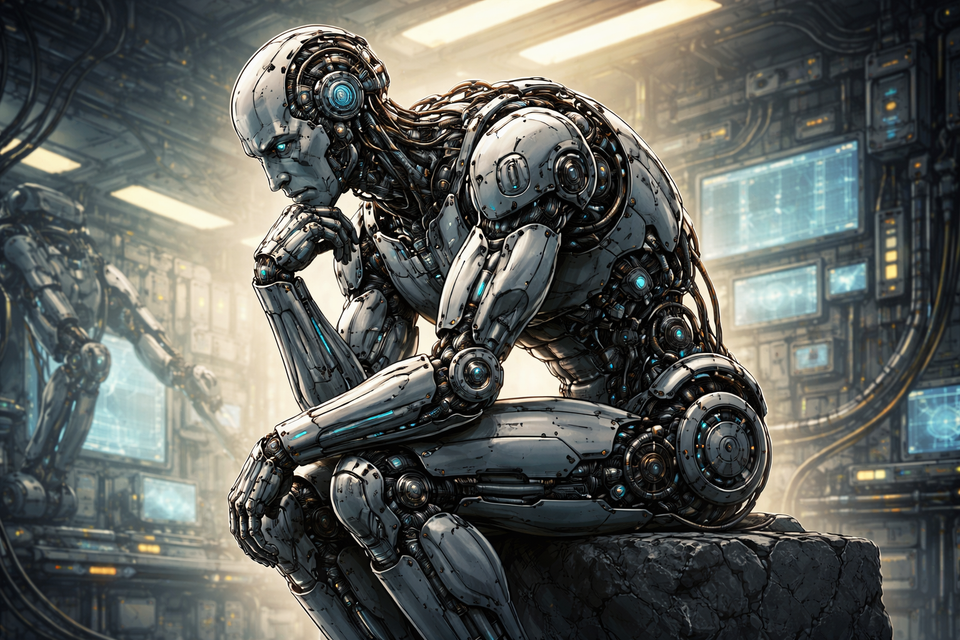
One thing that I think about a lot is not thinking a lot about what I don't think about a lot. That's cute, but also true. All I'm saying is that I wish I had more time to think. And I really do think about not having enough time to think. And it's something I've been thinking about – and writing about – for years.
I think about this because it's only in the moments where I do find time to think that I think about such things, and realize what a shame it is to not have that time in our modern world. At best, we all have a sliver of the time we used to have.
And while I suspect every generation talks about – and yes, thinks about – this issue with their own waves of technology entering lives and changing such dynamics, I do also believe that the past 25 to 30 years have accelerated the change. Basically, the internet was step one, the search engine was step two, the smartphone was step three, and now, of course, AI is step four.
To be clear, this isn't some sort of "TV is rotting your brain" argument – well, it might be, in a way – but it's not really about the content here. Some of it is good, some of it is bad (the same, of course, could be said for television), but it's the fact that it's just everywhere, every second of every day. Basically all of human knowledge and output is right there in your pocket and so it's going to be right there in your hand when a free moment of time opens up. It's not necessarily good or bad – again, it can be both good and bad – it's just reality. And such reality has rendered thinking, the process of actually getting lost in thought, all but extinct.
People talk about this in the context of "boredom" and how it has been more or less eliminated from lives thanks to the above technological steps. Boredom obviously has a natural negative connotation, but in recent years everyone seems to have woken up to some upsides to it. One, beyond perhaps learning patience, is thinking. Letting your mind wander. Because there's nothing else to do.
Again, I can only speak for myself, but with the benefit of hindsight, I actually think it was pretty critical to my childhood and growing up. Thinking obviously isn't something you learn how to do, but at the same time, I believe that if you don't actually practice it, you naturally won't be as good at it as someone else who devotes more time to the lost art.
And that alone may be the best argument against kids and smartphones. Ensuring they have that time to think without the endless feeds and streams. And to learn how to think without Google and now ChatGPT.
This is one of the things I love most about writing. It's a forcing function to make you sit down and think. Sure, there are still distractions, but at least for myself, if I can actually sit down to do it, I can focus and thoughts naturally form. This is happening right now. Even though I've thought briefly about this topic most of the day, only to allow myself to be distracted by something else so as not to fully think about it. But it's the input that matters just as much as the output. And I suspect the entire world is going to wake up to that notion in the Age of AI.
Listening to the people building this new technology and setting forth the notions of what change it will bring, you hear time and time again the notion of freeing up time. I have a hard time believing this will be the case because history is full of examples where time freed up by technology is simply filled in by other things. The positive side of that equation is that it often naturally means at least some level of productivity growth. And that comes with a potential silver-lining in that while there are all the fears of job displacement, it's very likely that people find new jobs to do (while yes, recognizing that there will likely be a transition period that is rough for many). The negative side of the above is that we end up in a state where we're somehow busier than ever.
Again, that would be my guess as to one way AI plays out at the highest level. The new technology starts being deployed to do more things that we currently do, but instead of going to the proverbial or literal beach, we just find new things to do. This is not profound, it's prosaic. It's simply what always happens.
And with my argument above, it's a bad situation because that beach would have at least theoretically given us all more time to think. And I think that could be a really good thing for humanity. But instead, I suspect, we'll continue to think even less.
Those building AI also like to paint a picture of the technology achieving breakthroughs that humans simply cannot. Or, perhaps we could, but it's more a matter of happenstance when we do. Like the ideas around scientific discovery, where they're basically using AI to "brute force" every possible scenario in a way that no human could do in a lifetime. That's undoubtedly a good thing – and likely a very good thing – for areas like drug discovery. But it still points back to the world where humans have stopped achieving such breakthroughs because we've stopped thinking. We've essentially outsourced the thinking to these thinking machines that are far more capable of thinking at scale than we can ever hope to be. So why bother?
Yet we're undoubtedly also too heavily discounting some intangibles there, like "eureka" moments. Perhaps they are simple matters of chance where a human stumbles into something by simply thinking. But you do have to wonder what is lost if those go away... Especially if you believe that machine thinking is not the same thing as human thinking, and that there are plusses and minuses to each, but that the human brain may, for example, introduce chemical variables that leads to an output – a thought – that a machine can only replicate after the fact but can't come up with out of the blue.
And what if it's the mere process of thinking that matters to humans, not the actual thoughts? Again, the inputs, not the outputs.
And yes, you could say that humans should work with the machines to augment such breakthroughs. And it's a nice thought and I hope that it happens. But it also seems just as likely that we'll continue to offload more and more to such systems while we go and do something else. It's like how no one knows phone numbers any more, or directions, or math, or spelling, or many, many other things where we've essentially outsourced such knowledge to different types of technology over the past few decades. Again, this is convenient and good in many ways, undoubtedly even most ways, but there are also downsides to offloading all of this.
Over the past 20 years or so, we've all learned to just Google something when we don't know an answer. And AI is the evolution of that, with even less human hunting – and yes, thinking – needed. "I've given that to my AI to think through and I'll be alerted when it's done." This is happening. Right now.
We used to have to take time to think about things. To remember things. And that naturally led our brains in myriad directions. To wander in our minds. But we don't really do that anymore. And I fear we're on the edge of doing that even less!
Anyway, just a thought I've been thinking about and yes, avoiding thinking about.

Thanks for reading, if you enjoyed this, perhaps:
🍺 Buy Me a Pint
⭕️ Join The Inner Ring
 M.G. Siegler
 M.G. Siegler