
About Those "Hackquisitions"...
The news that Noam Shazeer is (once again) leaving Google seems like a big deal. The news that he's joining OpenAI, which turned the transformer paper he helped write into a product that he couldn't launch (in his first stint) at Google seems like an even bigger deal. Bigger still may be the fact that he had rejoined to help the Gemini product take on ChatGPT, which was seemingly working, at least to some degree. But actually, the biggest deal has to be the actual deal that brought him back to Google. Because it wasn't even two years ago when Google paid $2.7B to bring Shazeer back.
And like that – poof – he's gone.
To be fair, there were others on the Character.ai team that Google seemingly wanted too. The non-exclusive licensing rights for Character? Probably less so. If anything, that aspect of the deal has ranged from a headache to a nightmare.1 But clearly it was a deal structure in such a way to get Shazeer back with an offer he couldn't refuse. And he didn't. Until he did. Again.
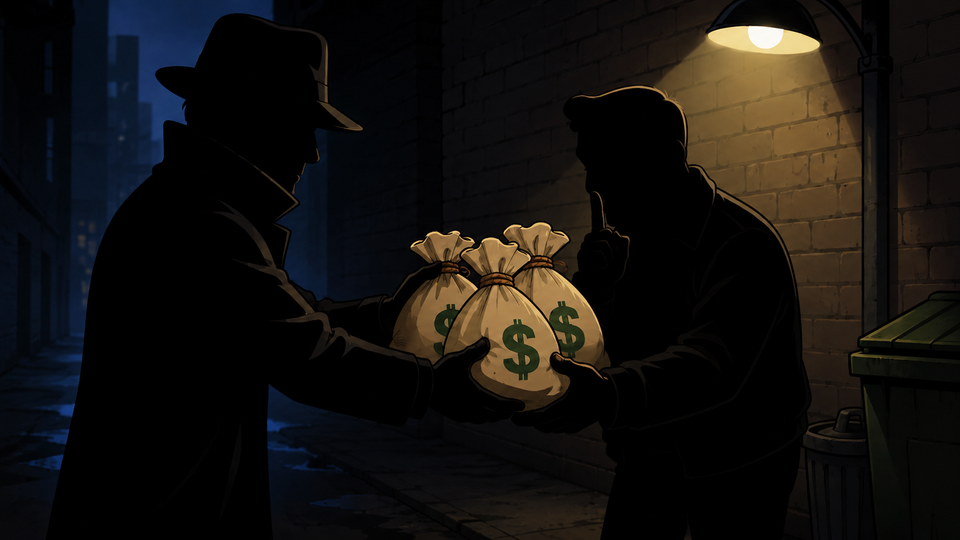
That deal structure, of course, was one of the early "hackquisitions" – a deal to bring on a company's key talent without acquiring the company itself. Because that clearly would have been messy from a regulatory perspective for any of Big Tech. If nothing else, such deals would be bogged down for months while they're scrutinized. A "hackquisition", by contrast, could be done almost instantly. Because they were structured to leave the actual company behind as a sort of hollowed-out husk. Not exactly a carcass because they weren't exactly dead but not fully alive either. A place to pick up the phone if the government calls. And to collect licensing fees.
And again, the deals were set up in ways so that those with power couldn't really say "no" – be it the founding team or investors. The employees left behind sometimes got screwed, but the "hackquiring" company often tried to do the right thing so as not to draw that eye and ire of Washington.
As such deals kept happening, Washington obviously started to look at these deals anyway. But the pace at which Washington moves have allowed them to continue unabated. Of course, something else now runs the risk of ending such deals: the fact that they don't seem to be working out. Let's look back at some of the big ones.
Microsoft/Inflection
The first such "hackquisition" clearly drew inspiration from the deal Microsoft almost did with OpenAI employees (from Sam Altman on down) during "The Blip". Such a deal, had it happened, would have looked pretty wild now given that OpenAI is valued at $852B. And, of course, constantly clashing with their benefactor. Anyway, as a result of Altman and OpenAI getting back to work, Microsoft turned their gaze elsewhere – to the AI startup co-founded by their board member Reid Hoffman.
But that deal wasn't about bringing Hoffman on board beyond the board, it was seemingly all about bringing on Mustafa Suleyman, a co-founder of DeepMind who left after the Google acquisition and started Inflection with Hoffman, raising a ton of money (for the time) in the process. After failing to get any sort of early traction and undoubtedly needing to raise billions more to effectively compete, it was seemingly an easy call when Microsoft came calling with $650M.
Again, not for the company, but for Suleyman and his team (and for the investors, which, yes, also included Hoffman). Fast-forward to today, just over two years later and Microsoft is certainly more independent in AI. But they're not necessarily in a better place, as the many re-orgs and re-brandings of Copilot have showcased. Meanwhile, Suleyman himself was recently moved from spearheading that product and team to focusing on foundation models instead.
$650M is relatively small by today's AI standards, but it's not clear what Microsoft actually got out of it. The consumer version of Copilot made to look like Pi, Inflection's product, clearly hasn't worked. And the team is now led by someone else so...
Amazon/Adept
A few months after the Inflection deal, that other Seattle-based tech company tried their hand at a "hackquisition". The deal for Adept was roughly half the size at $330M, but the idea was the same: get the co-founders on-board with Amazon's AI team. Most notably, David Luan was tasked with starting their "AGI Lab".
We're not even two years removed from that deal and yet 4 of the 5 Adept co-founders have already left Amazon. That includes Luan, who had previously worked at both Google and OpenAI, and left this Amazon past February. That team did launch one product, Nova Act, but it's not clear how useful that actually is to Amazon.
Amazon/Covariant
This deal, just a couple months later, was more under-the-radar than Adept, but may have actually been slightly larger. It has also been an even bigger headache, with a whistleblower saying that the left-behind Covariant company is just a "zombie" shadow company. Still, Amazon may have gotten some robots out of the deal even if the team seems to be pretty much gone.
Google/Character
We've been over this one.
Meta/Scale
The big one. While the nearly $15B deal technically structured a bit different than the other "hackquisitions" – namely in that Meta acquired a very specific 49% stake in Scale – the idea was still the same: bring AI talent on board to Meta, fast.
And specifically, Mark Zuckerberg zero'd in on Alexandr Wang as the guy who would reboot Meta's AI efforts, putting their Llama out to pasture, as it were. We all know what happened from here – mega offers led to mega chaos both around the entire AI ecosystem and within Meta itself. The latter is still playing out, with at least some believing that Wang's Scale culture and techniques are eating Meta alive from within.
At the same time, the new "Superintelligence" group has be able to build and ship their first models in record time. They're not yet frontier, but by all accounts they're good. So Zuckerberg, at least for now, has gotten the outputs he's wanted, though the inputs remain perhaps an issue. And Meta's stock has been hammered hard with investors still concerned about Meta's AI path going forward given the billions spent, with hundreds of billions more to come.
This is still more TBD – like the name of the sub-group Wang runs – but it's not trending particularly well if the moves really end up ripping Meta apart.
Meta/NFDG
A strange deal even by "hackquisition" standards. Meta essentially bought the book of Nat Friedman's and Daniel Gross' fund so that they could bring those two on board to help with their AI efforts. But that also mean Gross would have to leave the AI startup where he was not only a co-founder, but the CEO: Safe Superintelligence. Ilya Sutskever did not seem happy about that, as you might imagine. Especially since Zuckerberg had tried to "hackquire" SSI, but Sutskever shot him down (though Meta did apparently invest).
Friedman's role has seemingly shifted a couple times with constant re-orgs and shuffles in the aforementioned chaotic Meta environment. Gross is now working on Meta's infrastructure build-out for AI.
Google/Windsurf
This was a layered shitshow as OpenAI had originally agreed to acquire – as in actually acquire – Windsurf, then backed out (perhaps due to Microsoft). Google then stepped in to save the day – except the "hackquisition" nature of the deal led to a huge backlash because of the group being left behind, apparently without any sort of compensation. And so another AI startup, Cognition, stepped in to save the day from the already saved day. Fun times.
That brings us to today, while there have been a few other "hackquisitions", they're either too small or too new – most notably, NVIDIA's $20B mega deal to bring on board Groq talent, where yes, the IP license actually seems to matter – to know how well they'll play out. But it's pretty clear that the first crop didn't pan out as the "hackquirerers" would have hoped. At best, the situations are messy. At worst, they're shitshows – or really no-shows, with the talent now gone.
Shazeer is the biggest of those to date – again, in less than two years after a $2.7B deal. Can't wait to hear more about what happened there. But it could be as simple as these "hackquisitions" not aligning incentives very well...
Update October 13, 2026: The news gets even worst for Character.ai, with a Chapter 11 bankruptcy filing and IP sale that may be as low as $20M (to Disney)...
 M.G. Siegler
1 And yes, there are reports that Shazeer was a headache for Google too internally in this second stint. ↩