
Google Isn't Lazy, It's Timid. As It Sadly Must Be.
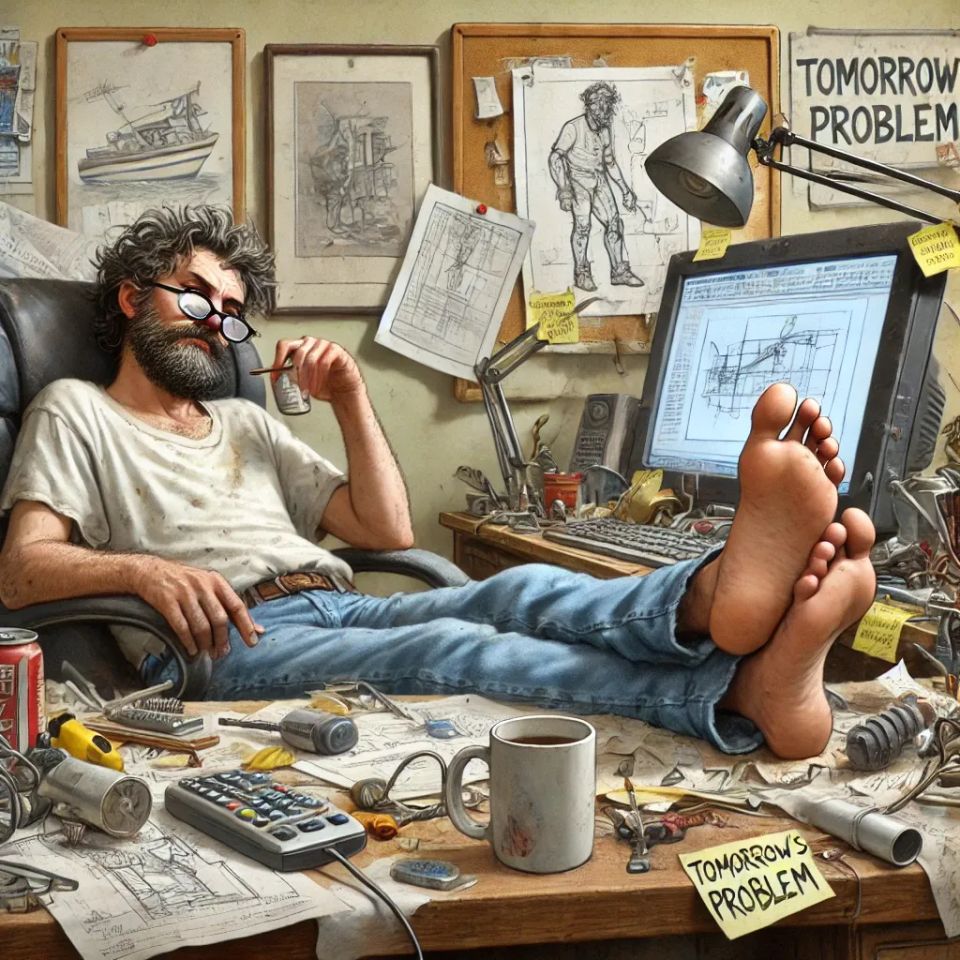
Eric Schmidt likes to say provocative things. Always has, always will. So when he says that Google fell behind in the AI race because the employee base doesn't like to work, I have two thoughts. First, is Google actually behind in the AI race? It feels like it depends where the finish line is... Second, in so far as they are right now – again, you could argue this either way, depending on what the measurement is, I imagine – it's not about hours worked on the problem.
Humorously, it seems that Stanford has taken down the video of Schmidt's comments – can't imagine why 😆 – but as Orianna Rosa Royle relays for Fortune:
Google’s former CEO Eric Schmidt has a complaint about his old stomping ground—and it’s one that workers have heard on repeat for the past two years: They aren’t working in the office enough.
Schmidt, who left Google for good in 2020, blasted the company’s working-from-home policy during a recent talk at Stanford University, while claiming it’s the reason why the search engine giant is lagging behind in the AI race.
“Google decided that work-life balance and going home early and working from home was more important than winning,” Schmidt told Stanford students.
“And the reason startups work is because the people work like hell.”
To be clear, there is some directional truth to this notion. "Rest and vest" has long been a good joke for a reason: all the best jokes have some level of truth to them. Is the typical engineer at Google working as hard as an engineer at some five-person startup? I mean, it's impossible to say, but if we want to generalize, then probably not. The stakes are simply much different, of course. But also, that engineer at Google doesn't need to work as hard because they have about 10,000 times the engineers around them to bolster the work towards whatever the goal is. This is just the way of things, which Schmidt obviously knows.
What I suspect he also knows would be my own opinion as to why Google is behind in this race – again, if you want to even consider them behind. It's not laziness, it's timidity.1
Google has some of the most amazing talent in the world working there. This has always been true, this remains true. Sure, people leave, but new talent comes. To think that they don't have the talent to do whatever they would want to/need to do in any field is just folly. Yes, they could be lazy on some level per above, but they're not all going to be lazy. Many are fresh-out-of-college grads with a hunger to matter. What kills them is what kills AI projects: bureaucracy.
I have no inside knowledge here but my guess would be that nearly every breakthrough in AI over the past decade, Google (or their DeepMind division) has been working on internally. This is common sense.
So why not launch? Because the stakes when you launch something at Google – and certainly something which in some way is controversial – are so much higher. You could probably ping hundreds, if not thousands of Googlers about the launch of any hyped-up-AI feature or company and they would likely tell you, "we had that, we just couldn't launch it".
Fucking Uncle Ben. Sonofabitch always becomes the North Star: with great power, comes great responsibility.
OpenAI can launch whatever it pleases. If it ruins the world, oh well, it's a startup after all. If Google does that? Well, those forthcoming remedies in the antitrust case probably change, fast.
This is all natural forces at work that lead to eventual disruption. It's not that people aren't smart or they're lazy, it's that the stakes completely change depending on the size and impact of a company. As such, the incentive structure changes. Everyone can say they know this internally – and they can in fact know it – but it doesn't matter. History will always repeat here.
This is why Microsoft was especially ingenious in partnering with OpenAI on artificial intelligence. Beyond quickly getting up to speed and "owning" 49% of the leading company in the space, they gave themselves an arms-length way to tackle AI. Let OpenAI do the stuff they cannot, and they'll siphon off the stuff that's working and gets dampened down to be less controversial with time and competition. They'd never admit this, but come on...
It's fucking brilliant. Satya Nadella, man.
Google probably should have run this game plan with another AI startup. Perhaps instead of acquiring DeepMind outright? Though that's easy to say in hindsight (and that was a competitive process – and one hell of a deal!). With the current era of AI, OpenAI really was the first-mover and clear leader for a while. By the time other startups popped up, the investments by Big Tech were viewed a bit more skeptically from several vantage points. And so now we get the "hackquisition" era. Until that ends too.
In many ways, you could argue that all these companies are still too early to AI, when it comes to productizing and monetizing it. So Google's "problem" here, could end up being a strength at some point – just as it likely will for Apple. It's a perception problem right now, which does matter for things like stock price and employee retention and hiring in this critical space, but it feels closer to shifting with each passing day in the AI space.
Anyway, my point is simply that while Google may or may not be "lazy" compared to a startup, that has little to do with the AI race going on right now. Even if Google was first to the current wave of AI – and all the pieces were right there given that the paper that underpins all of this was written by Googlers and OpenAI itself was started, in no small part, due to the fear of Google controlling such future AI – they still would not have shipped something like DALL-E first, let alone ChatGPT. The only world in which that changes is a world in which Google is much smaller, likely still a startup. Throwing caution and code to the wind.
Update August 15, 2024:
And sure enough, Schmidt has now confirmed that he requested the video be taken down. He also says he "misspoke" in his talk:
“I misspoke about Google and their work hours,” Schmidt said Wednesday in an email to The Wall Street Journal. “I regret my error.”
But really that these comments were made public...
1 Yes, yes, I technically worked at Google for 11 years -- to the day -- but my day-to-day at the independent venture arm had basically nothing to do with actual Google. So take this to mean that I have no internal knowledge. And these are my own thoughts. ↩