
The AI Snow Globe is Shaken
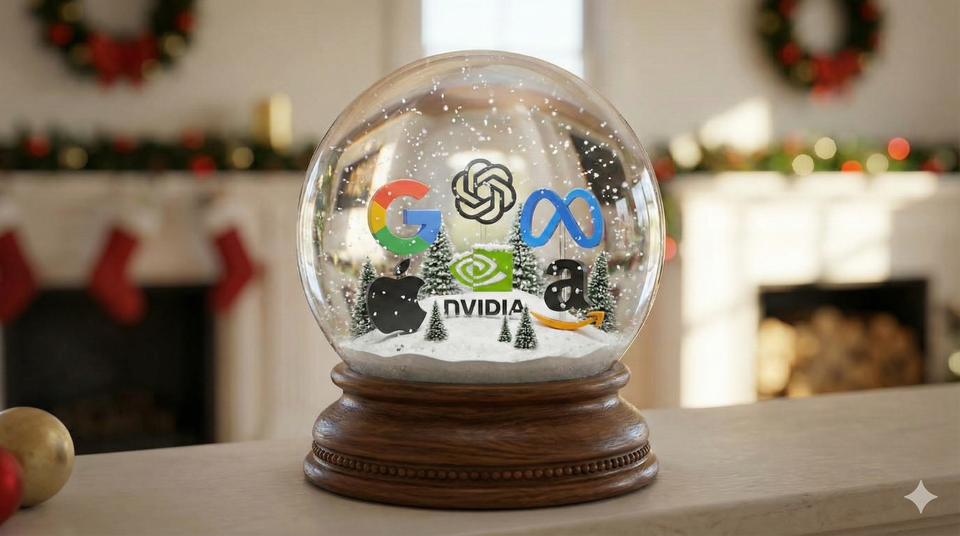
In case it wasn’t already obvious that 2026 is going to be a wild year for AI, just look at the end of 2025. Currently the biggest story in tech is that Sam Altman has issued a “Code Red” at OpenAI, aiming to light a fire under the company as they’re seemingly under attack for their leadership position in AI for the first time. And that hasn't even been the leading story atop Techmeme most of the day. Because with said AI war in full swing, Apple’s AI chief, John Giannandrea, is out.
He’s “retiring” which is optically the right thing for him and Apple to announce. But come on. It’s one thing for the CEO of Apple to be thinking about retirement with a brief lull in the action (for Apple, at least), while the company is near their peak in terms of sales and market cap, it’s another for the leader of what many would assume is the single most important technology for any company going forward to decide it’s a good time to retire. He’s retiring because Apple has been operating like the entire company is retired, at least when it comes to AI.
He’s retiring after a complete shake-up of his group both above him and below him as the company aims to reorient themselves for the coming AI battle. And he’s doing so ahead of any larger shake-ups so it’s not total chaos with so many people likely leaving in 2026. Including, perhaps, that aforementioned CEO.
Anyway, the writing was clearly on the wall with Giannandrea — just as it was with Yann LeCun, Meta’s former head of AI… Meta, um, decided to go in another direction, completely leaning in to LLMs as LeCun keeps leaning away towards "World Models". Which may or may not be the future...
Meanwhile, over at Amazon, they're releasing not only their own, new frontier LLMs, they're also releasing their new Trainium chips to help build said models. As well as the models from Anthropic, which makes models they both now compete with and use. Because the models from Anthropic are also going to be trained with TPUs from Google. And GPUs from NVIDIA too, it seems. Which is interesting since Amazon owns 20-something percent of Anthropic. And Google owns another double-digit percentage. Of course, NVIDIA will now be a smaller owner too.
They're also partnering with Microsoft, which is also working on their own, new frontier models, now free from the constraints of the previous deal with OpenAI which prevented them from going after AGI. They can now fully compete with those models, but also use them, since they own 27 percent of said company. While Microsoft is also working on their own chips, both they and OpenAI currently train on NVIDIA GPUs. At least until OpenAI also builds their own chips with Broadcom. Also, they're going to work with AMD's chips in some capacity too. But at least for now, they're not training on Google's TPUs, as a $100B commitment from NVIDIA may have snuffed that possibility out.
For now.
And that alignment makes sense because the main reason for the actual "Code Red" at OpenAI and the de-facto "Code Red" at NVIDIA in recent weeks is seemingly mostly about Google. Gemini has not only gotten good enough as a model, but is clearly getting good enough as an actual product to eat into ChatGPT. And there's real fear that the models are improving in ways that have surprised OpenAI on the pre-training front, and that may have something to do with said TPUs. Which is also potentially a problem for NVIDIA. Is "Garlic" a remedy? Nobody knows.
Regardless, the fact that Google is able to train cutting-edge frontier models without GPUs is clearly not a narrative NVIDIA likes floating around out there. Especially the talk of others using the TPUs. But even worse than Anthropic using them in Google's Cloud would be the notion of Google selling their chips to Meta to use in their own infrastructure. In some ways, this is worse for NVIDIA than the debate around chip depreciation and even circular financing. Because margins tend to get less fat and profits tend to get skinnier as competition enters the picture. And everyone that NVIDIA partners with is also seemingly trying to enter that picture.
As they continue to hammer money into NVIDIA...
And so we're entering 2026 with the broader AI landscape perhaps even more unsettled than it was entering 2025. That was, of course, right before DeepSeek entered the picture – well, technically right after, as that bomb landed and yet didn't explode for a few weeks. Once it did, it sent all of the players above scrambling. But they also soon realized that practically speaking, not much had changed. Still, it caused a mentality shift simply around the notion that things could quickly change. (And maybe to some extent about "open source" models – unless you're Meta – and certainly MoE techniques – sorry, Meta) And that has continued throughout the year.
So in a way, it's fitting that we're ending the year with things more chaotic than ever. Google, which had been depressed much of the year – at least from a stock price perspective – seemingly woke up at Google I/O and slammed their foot on the gas. The ramification of which we're just seeing now with Gemini 3's release.
And it's the first time that OpenAI's general lead in the space has felt threatened, perhaps outside of the DeepSeek blip. They started out strong from a product perspective and kept getting stronger with viral hit after viral hit spurring more usage. But Code Reds don't lie, and even Colonel Jessup can't lie about them. Such an order worked for Google a few years ago. Will it work for OpenAI?
It's weird timing for such an order, given that the company had just brought on a new "CEO" of their product division. Now seemingly everything that Fidji Simo was brought on board to oversee is taking a backseat to getting back to the fundamentals. And the actual CEO is seemingly back to overseeing those, and issuing Code Reds.
From the outside, it has long felt like OpenAI may be trying to do too much. This is seemingly an indication that the company also now agrees. The shopping agent stuff takes a backseat, as does the daily briefing work, as do the ads. The latter wasn't actually rolled out yet, but code leaks suggested it was coming imminently – and that was undoubtedly another key element of Simo's involvement, given her previous work with both Facebook and Instacart. Awkwardly, these product initiatives were likely three of the key pillars of ramping revenue. If those are paused, is burn about to get even hotter?
And none of this even speaks to the ongoing issues with AI safety, and China, and the myriad other things in motion and in play...
Things feel... tense at the moment, to put it lightly. I mean, NVIDIA is just blurting out "ENRON!" at this point, coprolalia-style. If the markets start turning against AI spend, that's going to be a big problem, to say the least. Even though OpenAI isn't – yet – public, the trickle-down effects will be very real here. Talk of spending "trillions" could quickly morph back into mere "billions". An Age of AI Austerity.
If that comes in 2026 and the AI Bubble starts to deflate – it doesn't even have to burst – we might be seeing a lot more Code Reds.
Can the tech industry handle this truth?