
Begun, the Bundle Wars Have
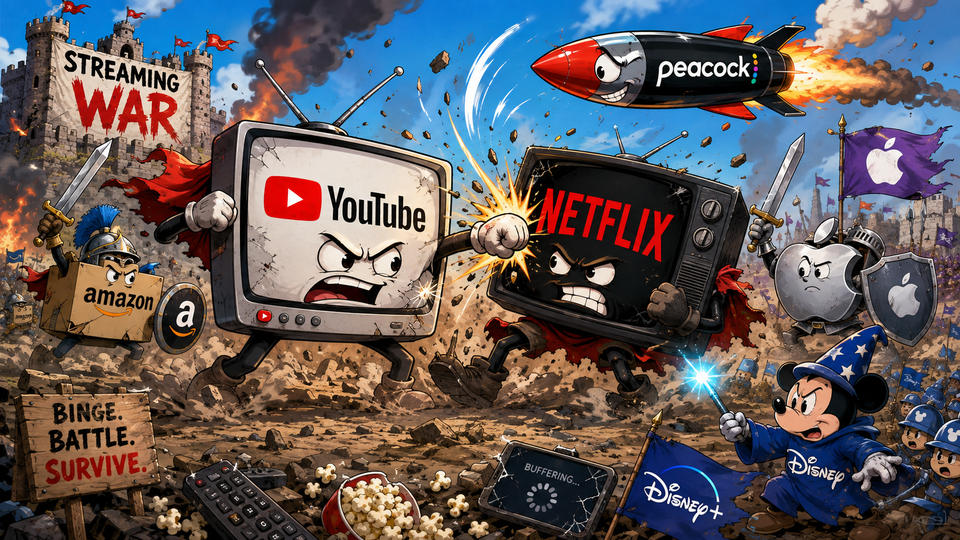
The streaming wars are over. Netflix won. Actually, YouTube may have won without anyone really realizing it until it was too late thanks largely to the guise of "UGC". Regardless, that battle is over. We've shifted into a new phase. And in a twist that will shock absolutely no one, it's the re-bundling of content after all the streamers worked so hard, and spent billions upon billions to unbundle it.
It's the early days of this new fight, so there's seemingly not much action yet. But I think we saw the opening salvo a few weeks back in the form of YouTube's deal to add Peacock to their Premium offering. To me, that was a shot over the bow of Netflix. A sort of "we're escalating – and not just with UGC".
Of course, Netflix must have seen this coming because it was a long time coming – ever since last year when Netflix teamed up with Spotify around video podcasts to wade into UGC for the first time. Since then, they've kept cutting deals left and right with YouTube talent to bring their content to Netflix. They may not be trying to become YouTube outright – that would be impossible at this point and scale – but they also know they need to play the game on the field, to switch analogies.
Again, YouTube sort of snuck up and stole home field advantage. As such, they now set the rules, by which Netflix must play.
Anyway, it's a game now, but it's about to be a war. And while it's bigger than just Netflix and YouTube, those are also clearly the two main combatants at the moment. Amazon, Apple, Disney and maybe a couple others will try to fight their way in – good luck, guys – but the prize is clear: to be the main UI for all content.
The New York Times wrote up this brewing battle yesterday with a piece by John Koblin entitled, "The Biggest Dogs in Streaming Want You to Use Only Their App". As he writes:
The push underscores the competitive reality for the titans of streaming television. Companies that were once laser-focused on gaining new subscribers are now far more concerned with keeping those people watching as much as possible, and canceling as little as possible. The result is that the streaming wars of a few years ago have morphed into the bundling wars of today. The biggest streaming firms are no longer content to just have the most subscribers. They also want to be the main entry point to everything streaming has to offer.“The thing that matters is that when you turn on the TV, what app are you opening for the next three hours?” said Jonathan Carson, the chief executive of Antenna, a subscription research firm.
Consumers are already showing enthusiasm for using one platform to manage their streaming subscriptions. Over the last three years, subscriptions made via third-party platforms like Amazon, Roku or YouTube have grown roughly 60 percent, according to Antenna. About a third of all new subscriptions are now purchased this way.
Koblin frames Amazon as the "runaway leader" pointing back to his piece on Prime Video 'Channels' from a year ago. And it's true that they were the pioneer and now leader with that strategy – letting you buy other subscriptions through their service. But I also can't help but wonder if they weren't too early here – which wouldn't be the first time for Amazon – and that while the strategy seems sound for now, with many trying to copy it, if the landscape shifts, even if just in subtle ways, it may tilt towards YouTube and Netflix.
Again, I think YouTube's Peacock deal may signal this shift. It's not an upsell, it's included. I still sort of can't believe Comcast agreed to this, but it also speaks to YouTube's power – and Peacock's position in the market. Comcast needed to find a partner and/or a home for their laggard streaming service. And they did.
And that makes the news that Netflix has also been talking to Peacock about potentially bundling their service even more interesting. Here's Koblin:
Netflix executives recently discussed bringing Peacock and Fox One to Netflix’s streaming service with NBCUniversal and the Fox Corporation, the three people with knowledge of the discussions said. They added that there was no imminent deal to be announced, and that it was not yet clear whether Netflix would absorb the content into its own service, as in the YouTube-Peacock deal, or act more as a retailer in the mold of Amazon Prime Video.
But any move in that direction is a departure from what Netflix said just two years ago, when the company told shareholders that it “already operates as a go-to destination for entertainment.”
But actually, this Peacock news isn't new – The Wall Street Journal's Jessica Toonkel and Ben Fritz reported on it almost two months ago. What changed since then is that YouTube/Peacock deal. As I wrote when that news came out:
All of this is clearly not great news for Netflix. Not only were they said to be exploring a Peacock add-on option – which still could happen, again presumably as a "Channel" within Netflix as a way for Comcast to continue to hedge – but the bigger issue is that this seemingly vaults YouTube into pole position as the default UI for streaming.
It felt a bit like the YouTube/Peacock deal was also a way to stop Netflix from striking their own partnership. This new report might suggest that such conversations are still ongoing, or simply that they happened (which, again, we already knew). That was my big question around that news:
The biggest question remains how the actual deal is structured. Beyond direct monetization of their content on YouTube, presumably there's a broader revenue share in place too. The bigger question is if there was some sort of up front, lump-sum payment, or ongoing licensing payments. That feels likely, but we'll see. And if so, that may give some level of exclusivity to YouTube? Maybe Comcast can keep their existing partnerships in place as long as they're more of the aforementioned "Channels" or straightforward bundle variety? Maybe YouTube would even prefer that lest they draw the eye of regulators here. But this type of deep integration may be exclusive to YouTube?
Again, that last bit is key. There's a world in which Peacock keeps doing their 'Channels' distribution deals with others, but the fully integrated approach is exclusive to YouTube. Or even if such a thing isn't in the contract, maybe Comcast decides they're only going to try it with YouTube for now, to see how it goes?
On the surface, it seems like a small distinction: both models allow you to access the other content in the main service. But baking it in, fully integrated and "native" without the need for an up-sell, could be the type of UI/UX that wins the day. First and foremost because all the 'Channels' model really does is shift our endless streaming payments and options to one provider – but you're still going to be paying an insane amount of money if you opt-in to all the options. Sure, it's a better experience than having to manage 20 different streaming services separately, but it's not as nice as what YouTube and Peacock are offering here.
And actually, that deal sounds more akin to the one Netflix struck with TF1. That is, bringing the French cable giant's content natively into Netflix. The end result is apparently pretty great. And working, to the point where TF1 is praising the partnership in their earnings calls.
Last December, as Netflix was still battling to buy Warner Bros, I outlined what I thought was their "grand unification strategy" – basically: how they would eventually take the TF1 model and pair that with baking HBO content into Netflix as a more premium offering to lure others into such partnerships, thus creating the "one UI to rule them all". A "Super App" for streaming, if you will.
Some content fully integrated, some upsold – undoubtedly at a nice discount thanks to the magic of bundle economics.
Well, the Warner deal didn't happen. Still, I noted at the time that even if it fell apart, I suspected Netflix would run the same playbook, but that it would just take longer. And here we are. But again, now YouTube may be on the ground mucking up their strategy, by beating them to it.
And that's why, even if this YouTube/Peacock deal isn't exclusive, I suspect we'll start to see some exclusive deals cut. And yes, undoubtedly some acquisitions. Things like Lionsgate. Maybe AMC. Perhaps eventually Peacock and/or NBCUniversal in an actual acquisition. Both Netflix and YouTube will be looking to bulk up for battle.
Again, Amazon may feel bulked up given their position and first-mover advantage with 'Channels' – not to mention MGM – but I still think the ground is shifting. Maybe sports can propel them, but everyone else is playing there too.
Various parties will start to align (or be aligned) around those perceived to be the likely winners. It's sort of wild that Apple isn't one of them.
Yes, Apple TV – the artist formerly known as Apple TV+ – is good, but small. It really is the HBO of old. That's nice, but also sort of quaint in the world we're headed for. They had their iPod in the form of Apple TV – the box, not the aforementioned streaming service – but it was always at least two times too expensive to win the actual market.1 That was obvious, yet they seemed disinterested. The box never really graduated from the "hobby" that Steve Jobs introduced (alongside the iPhone) all those years ago.
Perhaps that's because Jobs himself was trying to be the one to "crack" the market. And as he told his biographer shortly before his death, he thought he had. But then he passed away and the project seemed to fade away. And we're all perhaps paying the price – quite literally – right now in the form of a couple dozen different streaming services, hunting and pecking around UIs to find what we want to watch.
Meanwhile, the cheap Roku boxes won the day. And now the FAST services are entering the fray to beam ads back into our eyeballs with a vengeance.2 It's depressing. Apple should have been focused on running the old iTunes playbook here, to unify the messy streaming world with a great UI and wonderful consumer experience – and while they seemingly tried, perhaps a few times, it was half-hearted at best. And they let, who else, Netflix block them every step of the way.
The content players needed to learn their lessons the hard way. Not exactly like the music industry before them with piracy, but instead by slowly bleeding out as they spent billions trying to compete with Netflix.3 And here we are. But again, without Apple in a strategic position to do much about it.
And so it falls to Netflix or YouTube to be the UI through which content will flow.
I've been writing about all of this for years and years. And it's playing out almost exactly as I thought it would – both the bleed out and the fact that Netflix and Amazon would be there, circling the battlefield like vultures. What I didn't see until more recently was YouTube's potential role – and again, that Apple wouldn't really have one, as the de facto aggregator, at least.
Of course, they could lunge right back into this race by, say, buying Disney. Look, I'm not even trying to spend Tim Cook's money anymore, it's John Ternus' money now! Maybe he'll have a less tight wallet! There are signs...
Disney, of course, is the other elephant in this particular room. They've been busy bundling too – but mostly with their own content, slowly roping Hulu and now ESPN into Disney+ as their new CEO, Josh D'Amaro, also tries to create that "Super App". But Disney doesn't quite have the purse strings that the other players do here. They have the best content and IP, which is important leverage, but it feels like they're going to eventually be a player to be bundled, not a bundler.
If someone can grab that crown jewel... well, it might be the last Infinity Stone needed to win the war.
But let's not get ahead of ourselves here. The battles have just begun in these new Bundle Wars. But now we should look for the pieces to increasingly move quickly. Sports rights. Content distribution deals. Cable television partnerships. UGC deals. And potentially some major acquisitions in the Paramount/Warner Bros fall out.
A great bundling after we just un-bundled.
 M.G. Siegler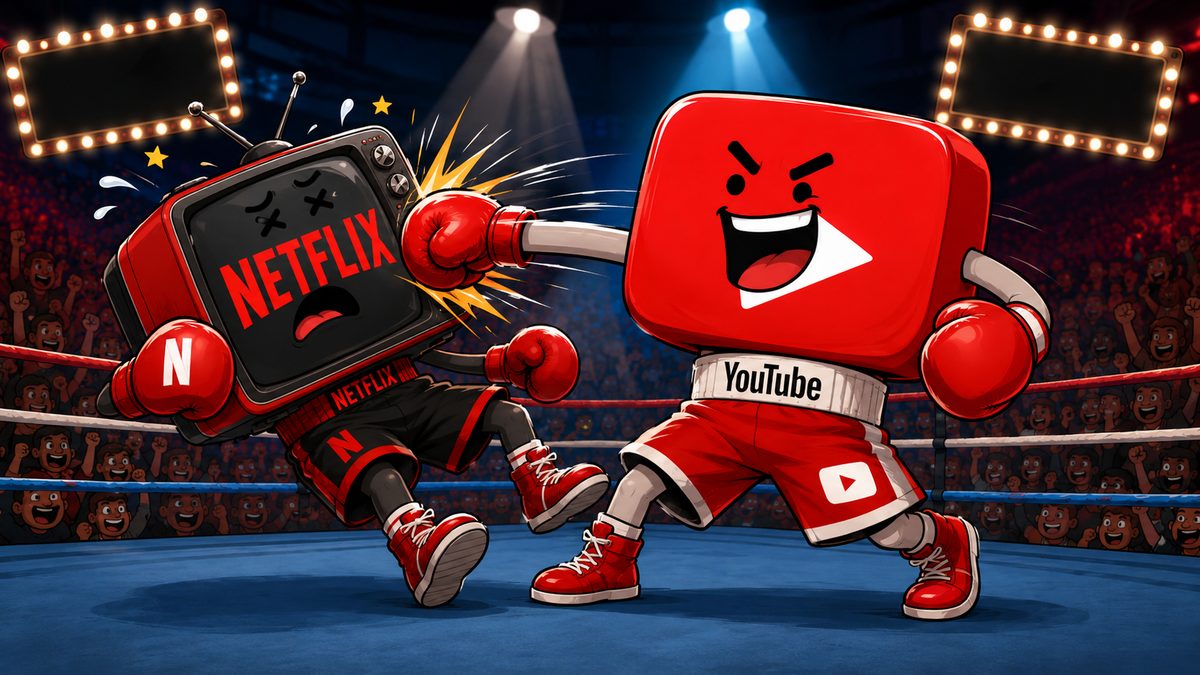
 M.G. Siegler
 M.G. Siegler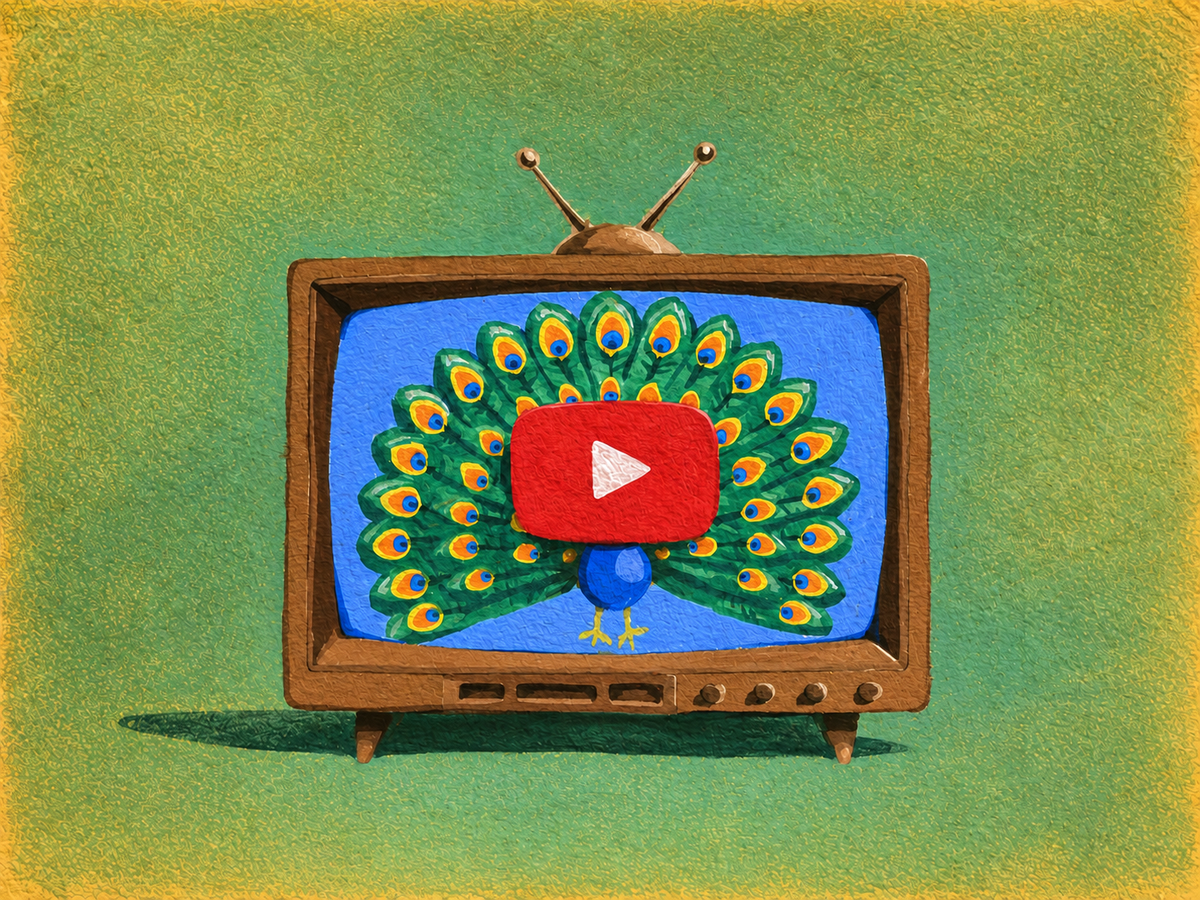
 M.G. Siegler
 M.G. Siegler
1 While you might counter that the iPod was also too expensive relative to the market at the time, the difference is how much better it was relative to that market – and yes, iTunes. Again, that's Apple's failure here, ironically, failing to nail hardware + software. ↩
2 Roku – which, ironically, started life as a Netflix skunkworks project – is obviously a major player on the 'Channels' side as well, thanks to the aforementioned cheap hardware. But I suspect the Fox acquisition may change that in the long run. Also, it feels like the time of the streaming box is ending with this new war. All new TVs have these services baked into their software. ↩
3 Pretty much everyone but Sony, who smartly opted to partner with Netflix instead. Which has paid off for both sides! ↩