
Reading Between the Apple v. OpenAI Lawsuit Lines
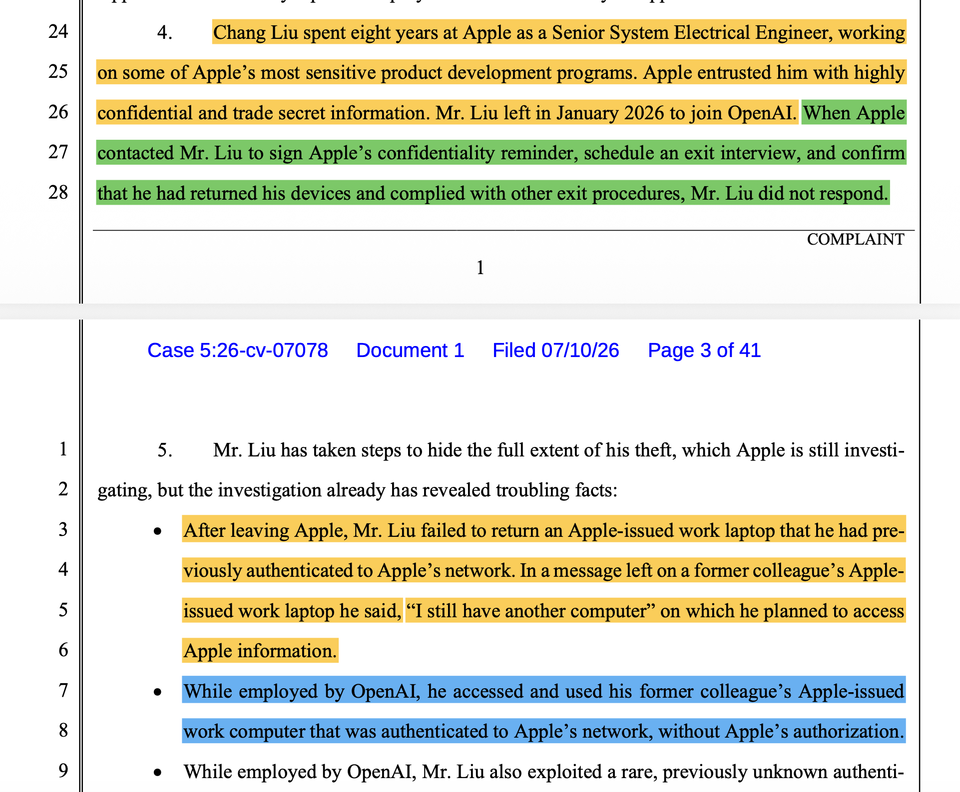
Have you heard? Apple is suing OpenAI. While I think my initial quick reaction after the Friday news dump remains correct at the highest level, having now read the full 40-page document, there's also – as expected – clearly a bit more nuance to the situation. Namely, while Apple frames OpenAI – or at least its fledgling hardware division – as "rotten to its core" (interesting terminology!), they really only have a case against two and maybe three individuals. But they also clearly believe that if this case goes to trial, they will have a case against a lot more.
That is to say, it's a fairly standard legal document. It's well-written, narratively, and fairly concise, but it still is very much making a one-sided argument in grandiose terms. That's the job to be done here. But in reading it, augmented by some of the reporting around the suit, you can start to see the contours of reality.
With the usual caveat that I'm not a lawyer and the allegations still remain just that, allegations, to which the other side has not responded beyond boilerplate ("We have no interest in other companies' trade secrets."), here's my current read of the situation...
First and foremost, again, if the allegations are true, Chang Liu, the former Senior System Electrical Engineer at Apple and now a Member of Technical Staff at OpenAI, is in a lot of trouble. At the very least, it seems safe to assume that he won't be working for OpenAI any longer. The real question would seem to be what kind of penalty he would face. The parallels to the Anthony Levandowski situation after he left Google for Uber have been drawn. Obviously, he was far more senior and high profile of a person than Liu is, still, the fact that he was sentenced to prison (before being pardoned by President Trump) for his actions is, well, not a great precedent for Liu. Again, they are just allegations at the moment, but Apple also would seem to have the receipts – many of them – because of the use of Apple-owned hardware for many actions.
It is interesting that Apple is not suing Yu-Ting “Alyssa” Peng, who is named in the suit as a co-conspirator with Liu while she was still employed at Apple, before she also subsequently went to work at OpenAI. Is it possible she's cooperating or has cooperated with Apple in this investigation? Or that they hope she will in any would-be trial? Pure speculation, of course, but an interesting wrinkle given the receipts Apple also seemingly has there.
As for Tang Tan, the other named defendant here, Apple's case feels more nebulous. It seems pretty obvious that they weren't looking into his actions until after they came upon the Liu situation and subsequently found a few things, likely in scouring their systems for Liu-related information, that they felt they could use to bring a case against him as well. Including, most notably, allegedly emailing himself partner information before he left Apple and apparently asking would-be recruits to bring proprietary and potentially confidential information – including prototype hardware?! – to "show and tells".
This is not a great look under any circumstance, but perhaps especially not when you've already been accused of something similar by another company!
More murky would seem to be the endless talk of using Apple's internal codenames for projects to lure both recruits and partners into divulging confidential information – as if the codename was some sort of password that unlocks such details.
Anyway, the fact that Tan was an extremely high profile vice president at Apple and is now the most important person on OpenAI's hardware side (since Jony Ive is not technically a full-time employee) makes him both an obvious and key target here. Even if these allegations are found to be untrue or embellished, can he reasonably stay at OpenAI now? And perhaps that's the real outcome Apple is looking for here, as they clearly frame him as the ringleader of the 400-plus people who have come over to OpenAI from Apple.
Cut off the head of the snake and... chill the body to ensure the snake stops growing.
Speaking of, the sheer number of people who have moved from Apple to OpenAI would seemingly help make Apple's case here. Would a jury buy that so many people leaving from one company to another wasn't a coordinated effort? That itself wouldn't be illegal – thanks California for no non-competes/non-solicitation rules – but how/why those people came over with regard to IP and trade secrets would obviously be at play here. I mean, that's more or less the entire case!
And of course, the true leader of that movement is undoubtedly the aforementioned Ive in the eyes of many. Given the history of Ive and Apple, no matter the tensions, it's simply hard to imagine them ever going after their former – quite literal – knight. The optics of it alone would be hugely damaging to both brands. At the same time, it would be hard to believe that Ive would do anything so blatant to try to hurt Apple. Sure, he may want to compete to combat some of what he feels like he wrought with the iPhone, but it's just hard to see him doing something as nefarious as knowingly taking or directing others to effectively steal from Apple. Maybe that's naive, but again, Ive is not even mentioned in the suit.
Tan, on the other hand, perhaps had a reputation for "flying too close to the sun" while at Apple, as Bloomberg's Mark Gurman is reporting around the lawsuit. Perhaps even more intriguing is the notion that some felt he should have gotten the head of hardware role that John Ternus ultimately landed which, of course, has now vaulted him into the CEO-in-waiting role. So yeah, that's an interesting rivalry dynamic here!
As for timing, it would seem sort of wild that Apple knew about Liu having some level of access to what they viewed as their information in February 2026 (a couple weeks after his departure to start at OpenAI) but didn't bring about this lawsuit until nearly six months later. While they note that they reached out to OpenAI about a potential issue (and never heard back), it's not clear who at OpenAI they reached out to (nor is it clear who at Apple reached out). Was it simply to Liu himself or someone else? Was it a low-level "heads up" ping between IT departments or something that was elevated much higher? This may remain unclear until/if there's actual discovery.
But again, the fact that Apple didn't bring the lawsuit immediately suggests that either they didn't view it as a big deal at the time (perhaps they didn't know the full scope) or that they felt the need to build a case. To that end, Apple's statement to CNBC that "Recently, significant evidence has emerged..." could go either way.
It may be a bit too conspiratorial to wonder if Apple waited until the OpenAI IPO preparations were in process and/or the first hardware product development was far enough along for the timing here. But I mean, there's certainly a world in which these allegations sidetrack one or both things – if not outright torpedo them.
To that end, OpenAI's best path may be to figure out if there's a way to get Apple to settle here quickly. And that may be tough. While they did eventually drop their lawsuit against Gerard Williams III, the former employee who went on to start Nuvia to compete with Apple Silicon, they did so after three years. And they also seemingly didn't have the case that they do at least against Liu here. And again, the real key to that may not be Liu himself here, but unlocking a discovery process that unearths who-knows-what-else. If nothing else, it would certainly unearth what OpenAI is actually building hardware-wise!
Then again, Apple undoubtedly already knows that. After all, OpenAI is seemingly using some of the same suppliers per the lawsuit! And perhaps even some of the same materials, the proprietary nature of one in particular is sort of humorously focused in on in the suit – a "trade secret metal-finishing technique" that OpenAI allegedly tricked one of Apple's suppliers into doing for them!
But there, what Apple really might want to know about is if/when OpenAI intends to build a phone – or phone-like device. And if, as reported, they are, perhaps with those 400+ people who worked on the most popular consumer electronics device in history while at Apple, well, there may be a whole other can of worms there. Again, depending on what any discovery would unearth.
Sam Altman, of course, is no stranger to such discovery, but can he really sit through more depositions with more of his emails and text messages shown to the world casting him in an embarrassing (or worse) light? It just depends, I guess! The extent to which he's involved in any of the above – and clearly he's been front and center with OpenAI's hardware efforts alongside Ive – could be the latest in a string of not great situations to be in, to put it mildly.
It's also, of course, the latest not great situation for OpenAI itself to be in.
Regardless, if Apple really does intend to fully go through with this trial (remember that they'd be subject to discovery as well, something the famously secretive company has not historically liked in the past either), it presumably wouldn't happen until sometime next year at the earliest, and perhaps even later. Though hearings around injunctions Apple is requesting would happen far sooner. And all of that paints a picture where OpenAI may not be able to launch said hardware on their intended roadmap of later this year or early next.
Might that suggest that Apple is actually worried about what OpenAI intends to launch here? I mean, maybe! Again, they have 400+ of their former people working on it. But at the very least, they simply must view it as strategic to slow-down a would-be competitor. Apple would never say that out loud, of course. But come on. Does Cupertino want to compete against a new Jony Ive-designed product in the market? If nothing else, again, it's a bad look for them, optically!
That isn't a reason to launch such a lawsuit, but OpenAI gave them a reason! 400+ of them actually! And while it may or may not be just one or two employees acting on their own, the (now widely reported) fact that OpenAI was said to be considering their own lawsuit against Apple around the failure of their ChatGPT/Siri partnership could not have helped matters!1 Again, that was apparently happening in between Apple alerting OpenAI about a potential breach and this lawsuit being filed. That's why I said at the time that it was probably fairly stupid for OpenAI to poke the bear. But they did, and now the bear has woken up and is pissed off!
So again, upon full reading of the lawsuit, the nuance seems more clear but there are also some real remaining questions. Questions which only the discovery process and/or the actual trial would uncover. There are a least a half dozen reasons why OpenAI would seemingly want/need to settle such a case ahead of such a trial, but it certainly doesn't seem like Apple intends to do that right now! At the very least, it's going to bog OpenAI down for the next several months – and potentially years – and cast a shadow over the hardware side of the house.
Even if all the allegations are unfounded, this uncertainty will undoubtedly make some would-be partners question any allegiances. And it may send OpenAI back to the literal drawing board to ensure any hardware isn't touching anything close to IP that Apple controls.
So yeah, none of that seems great for OpenAI and their hardware prospects. And that's not great because it's perhaps the key differentiator they were hoping to have against the other frontier labs. Maybe that forces them to storm ahead anyway, at which point those injunction hearings will be awfully important...
It remains just wild that it has come to this. Just two years ago, Apple was using their biggest stage to tout ChatGPT and the partnership with OpenAI. Now it's all lawsuits, allegations, and name-calling. Rotten, indeed.
Update July 14, 2026: Bloomberg's Mark Gurman is reporting that despite the lawsuit, OpenAI intends to move forward with their first device – at least for now. Again, let's see what happens with any injunctions...
Update July 15, 2026: But their emails...
 M.G. Siegler
And their hardware...
 M.G. Siegler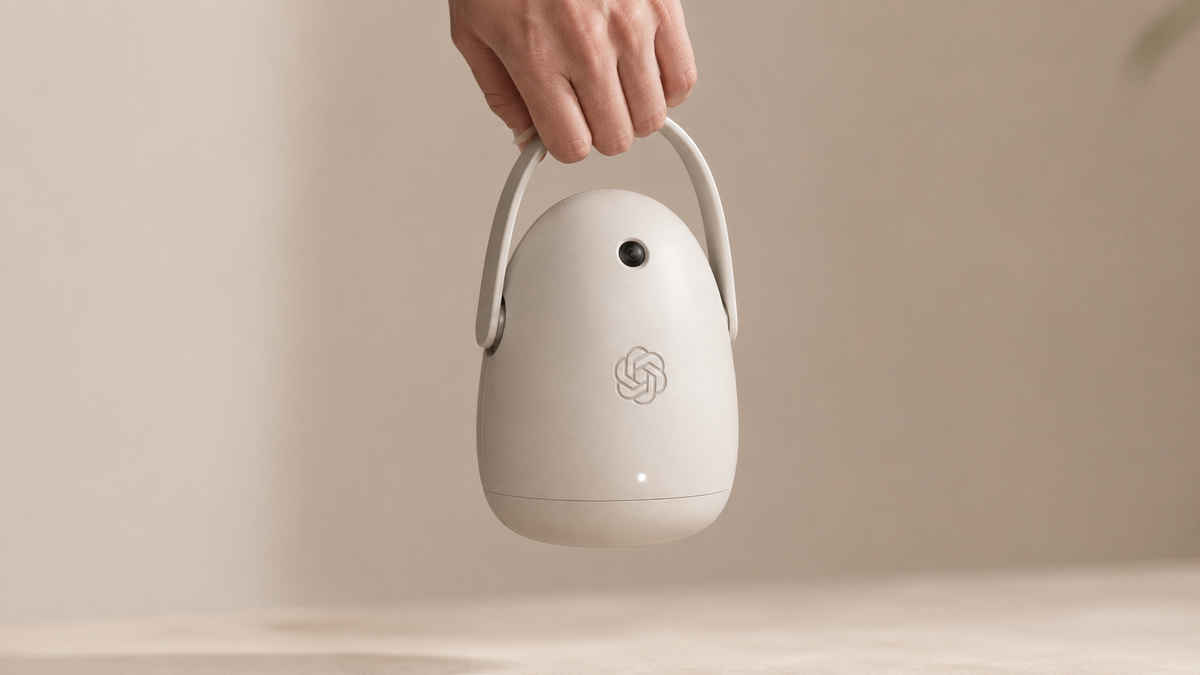
Update August 4, 2026: OpenAI finally responds in a meaningful way, publishing messages to try to show up Apple. But do they really?...
 M.G. Siegler
 M.G. Siegler
 M.G. Siegler
 M.G. Siegler
1 I suppose it's good that Apple doesn't have a representative on OpenAI's board – let alone an investment in the company – as was nearly the case a couple years ago! Then again, such an equity stake may have led to an easier path to ease tensions, just ask Microsoft! ↩